

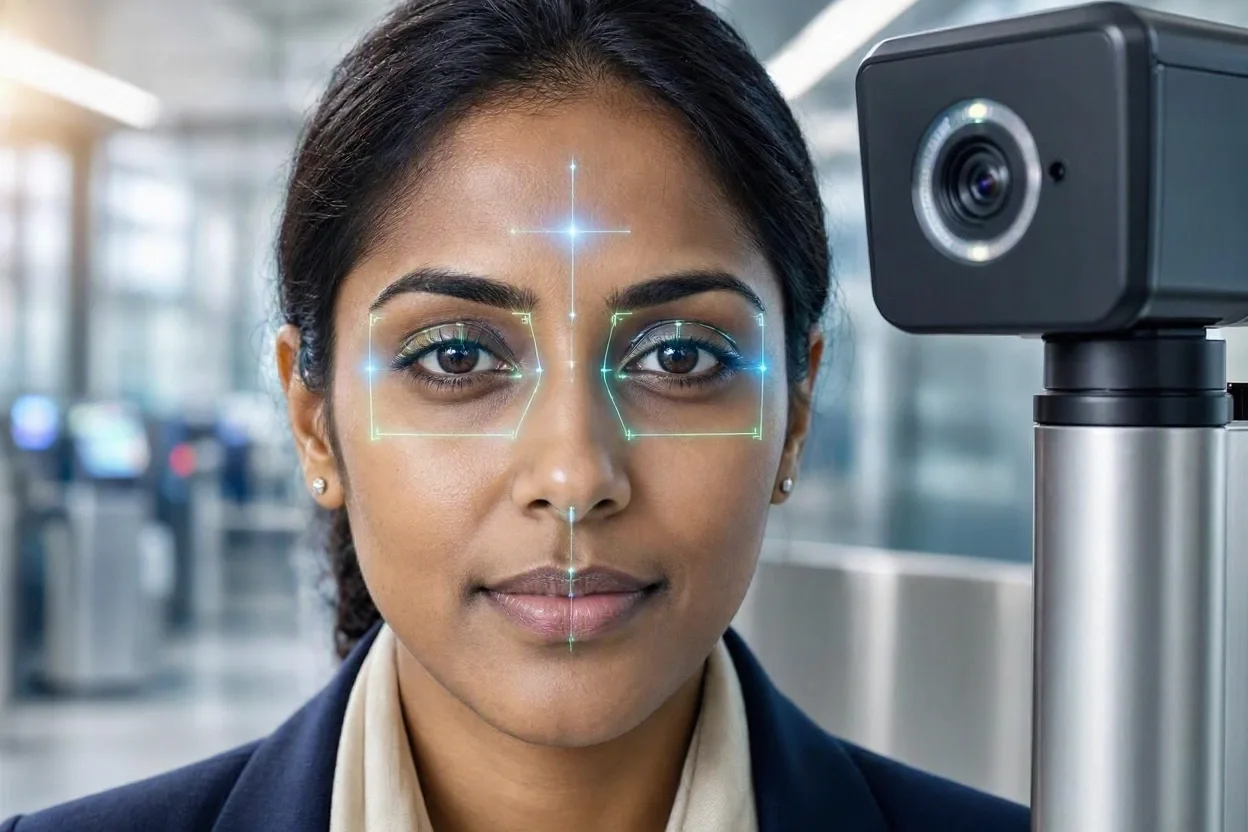
Specialized sensors can provide additional evidence when systems assess suspicious presentations at automated gates, giving border authorities information beyond ordinary visible-light photography while strengthening a layered biometric process that still depends upon facial comparison, document authentication, presentation attack detection and human oversight.
WASHINGTON, DC, October 25, 2026 , As airports increasingly rely upon automated facial recognition to verify travelers, specialized infrared imaging technologies can provide another source of information for determining whether a biometric camera is observing an authentic human presentation or something that warrants additional examination before an automated border decision proceeds.
Visible-Light Cameras See Only Part of the Picture
Conventional airport cameras generally capture visible wavelengths similar to those perceived by the human eye, producing photographs that contain substantial information about facial shape, texture, color and appearance but do not necessarily reveal every physical characteristic available from the subject standing before the sensor.
Modern facial recognition algorithms can extract considerable biometric information from those conventional images, locating important facial regions and translating their characteristics into mathematical representations that software compares against a trusted passport photograph or another reference image maintained by the responsible authority.
However, facial similarity and presentation integrity represent different security questions, because an image may resemble a legitimate passport holder while separate technology still needs to determine whether the camera received the kind of authentic physical presentation expected during a border inspection.
Researchers at the National Institute of Standards and Technology describe presentation attacks as attempts in which someone presents altered appearances, photographs, masks or other biometric characteristics intended either to impersonate another person or prevent a recognition system from identifying the individual correctly.
Infrared Sensors Observe Different Wavelengths
Infrared imaging extends biometric observation beyond ordinary visible light by using wavelengths that human eyes cannot directly see, allowing appropriately equipped cameras to collect information about how facial surfaces interact with illumination outside the conventional photographic spectrum.
Near-infrared systems, which operate close to visible wavelengths, are particularly relevant to facial imaging because they can produce recognizable facial representations while revealing reflectance characteristics that differ from those in a standard color photograph.
Those differences can become useful during presentation attack detection because human skin, paper, electronic displays and various synthetic materials do not necessarily reflect infrared illumination in identical ways, giving algorithms another category of evidence when determining whether a presentation deserves additional scrutiny.
The resulting information does not automatically identify an attempted spoof, because legitimate facial appearances, environmental conditions and sensor characteristics can also create variation, but infrared measurements can contribute another independent signal within a broader biometric assessment.
Human Skin Interacts With Light Differently From Artificial Materials
A person’s face contains complex biological tissue whose optical properties result from skin structure, pigmentation, blood, water and other characteristics, while common materials used to reproduce facial appearances possess substantially different physical structures even when they look convincing under ordinary visible illumination.
A printed photograph can reproduce colors, shadows and facial detail effectively enough to appear realistic to a conventional camera, yet the paper, ink and surface coatings producing that image can behave differently when illuminated at wavelengths outside those used for ordinary photography.
Electronic displays introduce another set of characteristics because the apparent facial image originates from illuminated pixels beneath a glass or polymer surface rather than from living tissue reflecting ambient illumination, potentially creating measurable differences when specialized sensors examine the presentation.
Synthetic masks and three-dimensional reproductions create more complicated challenges because their physical geometry may resemble a human face more closely, which is one reason infrared information is generally combined with other measurements instead of being treated as a universal test.
Infrared Imaging Can Complement Depth Measurement
Depth sensing and infrared imaging are sometimes discussed together because certain biometric hardware uses infrared illumination to calculate spatial information, although the concepts remain distinct because one concerns wavelength information while the other concerns the physical distance and geometry of observed facial surfaces.
A depth-capable sensor can determine that the nose projects forward from the cheeks or that the eyes occupy recessed areas, while infrared imagery can provide additional information about how those same surfaces respond to illumination outside the visible spectrum.
Combining these measurements can give automated systems a richer representation than an ordinary photograph alone, potentially allowing software to consider facial geometry, surface response and conventional appearance before deciding whether the captured sample provides an acceptable basis for further processing.
The importance of combining signals becomes clearer with sophisticated presentation artifacts, because a three-dimensional mask might meet some geometric expectations while showing material or optical characteristics that differ from those normally associated with a genuine human face.
Infrared Does Not Replace Facial Recognition
Even when infrared sensing indicates that a presentation appears physically consistent with a human subject, the system must still determine whether that person’s face resembles the authoritative identity reference associated with the travel document or immigration record being examined.
Facial recognition software consequently performs a separate comparison, generally analyzing a live facial capture against a passport-chip portrait or other approved image before producing a similarity measurement that the border system evaluates according to its operational thresholds.
A traveler could therefore pass one type of presentation integrity assessment while failing the actual facial comparison, just as a strong facial similarity score might still require additional review if another component detects unusual characteristics surrounding the biometric capture.
Separating these functions improves security because no single favorable result automatically answers every identity question, allowing document authentication, presentation attack detection, and biometric matching to provide independent evidence before automated processing concludes.
Presentation Attack Detection Has Become a Formal Security Discipline
Presentation attack detection, frequently abbreviated as PAD, has developed into an established area of biometric testing because organizations deploying facial recognition need methods for evaluating whether systems can distinguish legitimate presentations from attempts designed to interfere with normal recognition.
The latest NIST digital identity guidance requires presentation attack detection for facial recognition within covered authentication environments and emphasizes that biometric information itself should not be treated as secret, since facial images can often be obtained without the subject surrendering a protected credential.
That principle has important implications for border technology because the security of a facial verification system cannot depend solely upon keeping someone’s appearance confidential, making protection of the capture process and verification of the incoming presentation increasingly important.
Infrared imaging represents one technological approach available to developers, although operational systems can also incorporate visible-light analysis, depth sensing, motion information, challenge-response procedures and other mechanisms depending upon the security requirements and equipment involved.
Testing Shows Why Multiple Defenses Matter
NIST’s Face Analysis Technology Evaluation has tested software designed to detect presentation attacks using conventional two-dimensional imagery, providing valuable evidence about both the promise and limitations of algorithms attempting to classify suspicious biometric presentations automatically.
In one evaluation involving 82 algorithms submitted by 45 developers, researchers examined several presentation categories and found substantial variation in performance, with particular systems performing well against certain attacks but no evaluated algorithm successfully detecting every category included in the study.
Significantly, that particular evaluation examined software operating on conventional imagery and specifically did not evaluate approaches using three-dimensional sensing, near-infrared illumination or interactive challenge-response techniques, leaving those hardware-assisted approaches outside the scope of its conclusions.
The results nevertheless demonstrate why border authorities and system designers favor layered security, because a detector optimized for one presentation type cannot automatically be assumed to perform equally well when encountering a fundamentally different material, environmental condition or attack technique.
Infrared Can Help Under Difficult Lighting Conditions
Infrared imaging can also offer practical advantages unrelated to spoof detection because controlled infrared illumination lets certain cameras capture useful facial information even when visible-light conditions might otherwise complicate conventional photography.
International airports contain highly variable illumination, including bright daylight entering terminal windows, reflective architectural surfaces, artificial overhead lighting and darker areas that can produce shadows or inconsistent exposure as passengers move through automated processing areas.
A sensor with its own infrared illumination can reduce dependence upon some of those visible-light variations, potentially giving the system a more consistent source of biometric information while conventional cameras continue capturing the photographs needed for ordinary facial comparison.
Consistency remains important because biometric accuracy depends not only upon sophisticated recognition algorithms but also upon whether the camera obtains sufficiently clear and standardized information from each traveler during the brief acquisition period at an automated gate.
Eyewear and Reflective Surfaces Can Create Challenges
Infrared systems are not immune to environmental complications because glasses, reflective coatings and other materials can interact with specialized illumination in ways that obscure facial regions or produce reflections requiring careful handling by the imaging software.
A system designed for operational border use consequently needs quality controls capable of determining whether the infrared capture contains sufficient useful information rather than assuming that every image produced by the specialized sensor is automatically reliable.
When critical facial regions become obscured or measurements fall outside acceptable parameters, the checkpoint can request another capture or direct the traveler toward additional inspection rather than interpreting an incomplete infrared observation as evidence of deliberate wrongdoing.
This distinction is particularly important for public understanding because presentation attack detection systems make probabilistic assessments from sensor information, meaning unusual measurements can justify additional examination without independently proving that someone attempted to deceive the system.
Infrared Information Can Be Evaluated Across Multiple Frames
Automated gates frequently capture more than one image during the short period when a traveler faces the camera, allowing biometric software to evaluate information across time rather than depending entirely upon a single photographic exposure.
Infrared video or sequences of infrared frames can provide information about changing facial surfaces and movement, adding temporal evidence that may complement measurements obtained from conventional visible-light imagery, depth sensors or other components inside the biometric capture unit.
Natural human movement can include subtle changes around the eyes, mouth and head position, although robust systems must account for legitimate travelers who remain unusually still or whose physical characteristics affect expected movement patterns.
For this reason, no single blink, movement or infrared characteristic should be portrayed as a universal proof of liveness, because operational presentation attack detection generally performs more reliably when several independent characteristics contribute to the overall assessment.
Passive Detection Can Keep Border Processing Efficient
One advantage of infrared and other sensor-based approaches is that they can operate passively, meaning travelers may not need to perform conspicuous actions beyond standing where instructed and facing the camera while the system gathers the information required for its analysis.
Active liveness procedures can ask individuals to turn their heads, follow visual prompts or perform unpredictable actions, but these techniques may increase processing time and introduce usability concerns when thousands of passengers need to move through border facilities efficiently.
Passive sensors instead allow security analysis to occur within the ordinary capture sequence, supporting the operational objective of identifying routine legitimate travelers quickly while reserving more intensive examination for cases where automated measurements indicate uncertainty.
The combination of security and throughput is particularly important at large international airports because even small increases in processing time can compound across thousands of passengers and create substantial congestion during peak arrival or departure periods.
Infrared Cannot Authenticate an Electronic Passport
Infrared facial imaging remains entirely separate from electronic passport authentication, because determining whether a person appears physically genuine does not establish whether the passport presented at the inspection point was legitimately issued or whether its protected electronic data remains intact.
Modern ePassports contain digitally signed information that compatible inspection systems can authenticate using cryptographic certificates, providing evidence that protected data originated with the issuing authority and has not been altered since the government digitally signed the relevant information.
The stored portrait can then serve as an authoritative reference for biometric comparison, while infrared sensing and other presentation attack detection technologies examine characteristics of the person or presentation currently standing before the camera.
These processes reinforce one another because document authentication helps establish confidence in the reference identity, facial recognition examines whether the traveler resembles that reference, and presentation attack detection considers whether the biometric sample itself appears trustworthy.
Infrared Should Not Be Treated as an Infallible Defense
No security technology should be described as permanently immune from attack, particularly within biometrics, where researchers continuously examine how cameras, algorithms and sensing methods respond to previously unseen materials and presentation techniques.
The ongoing evolution of biometric research means infrared systems require testing against realistic threats and operational environments, just as visible-light presentation attack detection requires continuing evaluation when new reproduction technologies and artificial facial representations become available.
NIST’s work repeatedly emphasizes measurement rather than assumptions, with contemporary guidance focusing upon quantifiable error rates, standardized presentation attack testing and evaluation across realistic biometric conditions instead of relying solely upon manufacturer descriptions of liveness or spoof-detection capabilities.
That testing philosophy matters for border agencies because systems deployed across international transportation networks must function reliably across enormous populations, varied environmental conditions and constantly changing technologies while minimizing unnecessary referrals involving legitimate travelers.
Human Officers Provide Another Independent Layer
Automated gates can rapidly resolve straightforward cases, but human inspection remains valuable when infrared sensing, visible facial recognition, passport authentication or another automated component produces an uncertain or conflicting result requiring broader evaluation.
An officer can examine the traveler, document and surrounding circumstances while considering information generated by multiple automated systems, providing contextual judgment that a narrowly specialized sensor cannot independently reproduce.
Referral therefore represents a normal security mechanism rather than automatic evidence of fraud, because the purpose of an automated checkpoint is partly to identify situations that fall outside conditions where the technology can make a sufficiently confident decision.
This layered arrangement allows sophisticated sensors to improve efficiency without requiring border authorities to treat algorithms as unquestionable decision makers, preserving human review whenever technology indicates that more information should be considered.
Privacy Remains an Important Consideration
Expanded biometric sensing also creates legitimate privacy questions because facial imagery and other biometric measurements can constitute highly sensitive personal information whose collection, processing, retention and protection require clearly defined governmental safeguards.
Infrared imagery may appear unfamiliar compared with an ordinary photograph, but its use within identity verification still requires agencies to consider appropriate data governance, access controls, retention policies and security protections consistent with the purposes for which information was collected.
NIST guidance specifically emphasizes that biometric data should receive protection as sensitive personal information, reflecting the broader principle that stronger identity technology must be accompanied by security practices protecting the information created during biometric processing.
Those considerations become increasingly important as airports adopt more capable sensors, because the technical ability to collect additional biometric information does not eliminate the need for transparent policies governing how authorities handle that information afterward.
Modern Passport Security Depends on Independent Checks
Infrared presentation analysis fits into the same layered philosophy governing contemporary travel documents, where physical security printing, electronic chips, cryptographic authentication and biometric comparison work together because no individual feature can independently answer every question arising during border inspection.
Amicus International Consulting examines this broader structure in its guide explaining how modern passport security helps detect counterfeits and protect identity, including the relationship between physical document characteristics, digitally protected chip information and biometric identity verification during modern travel.
Adding infrared imaging does not replace those protections, but it can strengthen the point where the traveler interacts with the inspection system by giving appropriately equipped cameras another category of information with which to evaluate the incoming biometric presentation.
The strongest automated checkpoint therefore operates less like a single facial recognition camera and more like a collection of independent security mechanisms whose results collectively determine whether routine processing can continue or additional inspection becomes appropriate.
Infrared Imaging Expands What the Border Camera Can Evaluate
To most travelers, an airport face check still appears remarkably straightforward because the visible interaction usually involves standing before a camera, looking forward briefly and waiting for an automated gate or officer to indicate whether processing can continue.
Behind that simple interaction, however, the inspection equipment may evaluate image quality, facial similarity, presentation integrity and document information through separate processes, with specialized sensors providing evidence that an ordinary visible-light photograph could not supply independently.
Infrared imaging expands that defensive capability by observing facial presentations through wavelengths outside normal human vision, potentially revealing differences among living tissue, printed imagery, electronic displays and artificial materials that complement information collected by conventional cameras.
Its value ultimately comes not from replacing facial recognition or claiming perfect spoof detection, but from contributing another independent measurement to a layered border-security architecture designed to make automated identity decisions more resilient, explainable and difficult to mislead.