

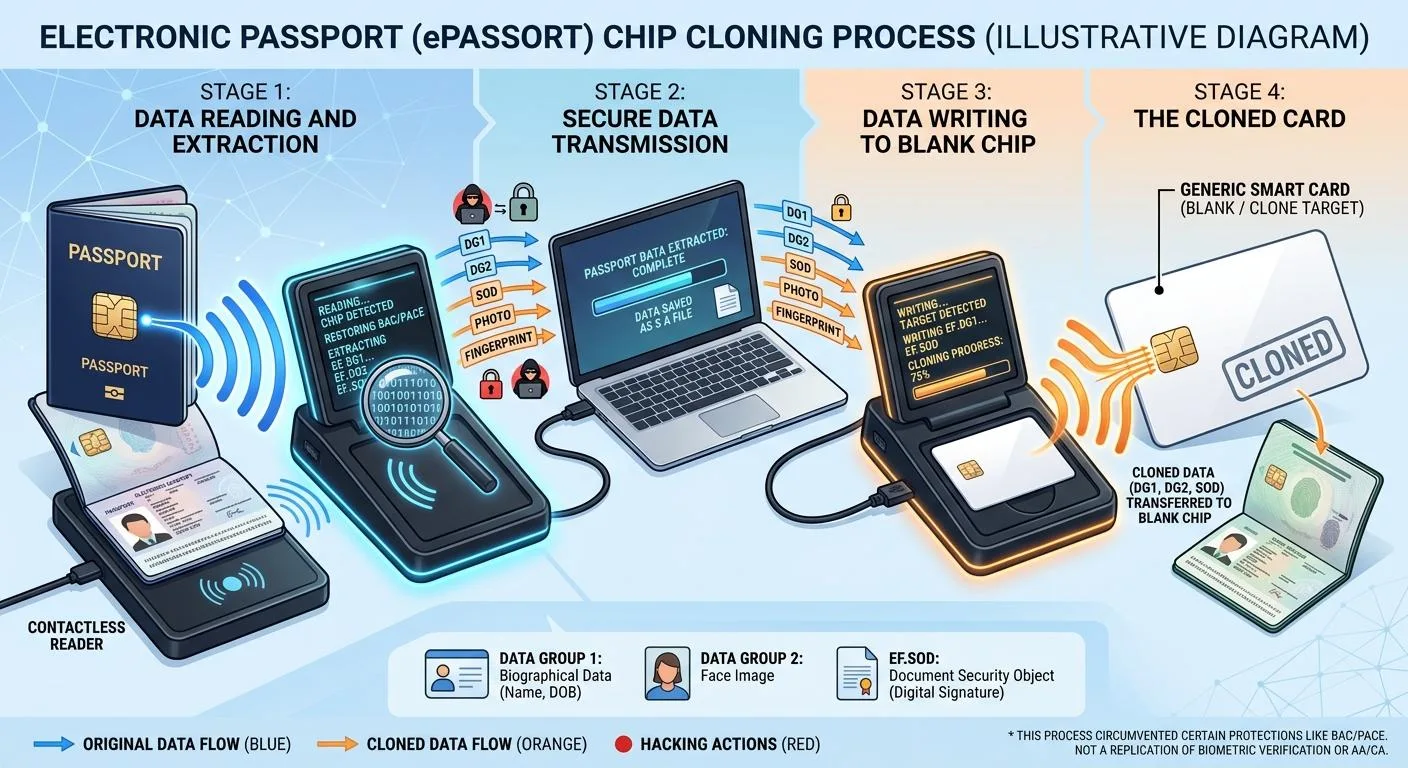
A cryptographic challenge tests whether the chip holds the private key that matches its authenticated public key.
WASHINGTON, DC, October 15, 2026 — Electronic passport security involves more than checking whether stored identity information carries a valid government signature, because someone could theoretically copy signed data onto another electronic component while preserving the original information’s mathematical integrity.
Active Authentication addresses that problem by allowing compatible inspection equipment to cryptographically challenge the passport chip, requiring the electronic component to demonstrate possession of a private key associated with a public key whose integrity has already been protected through the passport’s signed data structure.
Passive Authentication and Active Authentication Answer Different Questions
Passive Authentication determines whether protected information stored on an electronic passport remains authentic and unchanged, while Active Authentication provides additional evidence that the chip presenting that information possesses the cryptographic capabilities associated with the original legitimate document.
This distinction matters when considering cloning because an exact copy of legitimately signed passport data can retain its original digital signature, so data integrity alone does not necessarily prove the electronic component carrying those records is genuine.
Active Authentication Uses a Challenge-Response Process
Under the Active Authentication process described in ICAO Doc 9303 Part 11, the inspection system generates a fresh random challenge and sends that value to the electronic passport chip for cryptographic processing using its protected private authentication key.
The chip processes the challenge and returns a cryptographic response, which the inspection equipment can evaluate using the corresponding authenticated public key rather than relying exclusively on static information that could have been copied from another legitimate passport.
The Private Key Is Intended to Remain Inside the Chip
Active Authentication depends on the passport chip having its own cryptographic key pair: a public key available for verification and a corresponding private key intended to remain securely protected within the contactless integrated circuit.
ICAO specifies that the private Active Authentication key remains in secure chip memory, while Data Group 15 stores information identifying the corresponding public key and protects it through the passport’s signed Document Security Object.
The Public Key Must First Be Authenticated
A challenge-response process would provide limited assurance if an attacker could simply replace the public key with another key under their own control, because a counterfeit chip could then respond correctly using the attacker’s matching private credential.
Electronic passports address that weakness by including the public Active Authentication key within protected passport data whose hash is incorporated into the digitally signed Document Security Object, allowing Passive Authentication to establish confidence in that public key before it becomes the basis for the challenge.
The Reader Generates a Fresh Challenge
Unlike static passport data that remain largely unchanged throughout the document’s lifetime, the challenge used during Active Authentication is generated by the inspection system when the verification procedure occurs, creating a new cryptographic problem for the chip to answer.
Because the challenge is fresh rather than permanently stored inside the passport, simply replaying previously copied biographical information, photographs, hashes, or digital signatures should not provide the response required for successful authentication.
The Chip Uses Its Secret Key to Respond
After receiving the challenge, the genuine electronic passport performs the cryptographic operations specified by the supported Active Authentication mechanism and produces a signature-like response derived using the private authentication key stored inside the secure integrated circuit.
The inspection system then evaluates that response using the authenticated public key, allowing it to determine whether the responding electronic component possesses the secret cryptographic capability expected from the original passport chip.
Copied Static Data Are Not Enough
A straightforward clone could theoretically contain the same biographical data, facial image, Document Security Object, digital signature, and public authentication key as the original passport because all of those electronic records can remain mathematically valid when copied without modification.
However, those copied records typically do not include the protected private authentication key, so the duplicated device should be unable to generate a valid response when an inspection system issues a new challenge that requires that secret credential.
This Is Why Cloning Differs From Data Tampering
Electronic data tampering involves modifying protected information while trying to conceal the change, whereas cloning reproduces legitimate information onto another electronic device without necessarily altering any signed passport records.
Passive Authentication is particularly effective against unauthorized modification because altered data disrupt signed integrity relationships, while Active Authentication provides an additional defense against exact copying or substitution of otherwise legitimate electronic information.
The Security Comes From Possession of a Secret
Active Authentication therefore relies on a simple but powerful cryptographic principle: the electronic component demonstrates possession of secret information without revealing the private key to the inspection system performing the verification.
The reader obtains evidence that the chip can perform the required cryptographic operation, while the secret credential remains protected inside secure hardware rather than being transmitted across the contactless communication channel for the inspector to store.
The Challenge Is Not the Secret
The random challenge supplied by the inspection system does not need to remain confidential because its security purpose is to ensure the chip produces a fresh cryptographic response rather than merely replaying a previously observed authentication exchange.
An outside observer could theoretically know the challenge but still lack the protected private key needed to generate the correct response the reader expects from the authenticated public credential.
Active Authentication Builds on Passive Authentication
Active Authentication should not replace Passive Authentication because the reader needs confidence that the public key used to evaluate the response genuinely belongs to the passport, rather than being substituted by an attacker.
The two mechanisms therefore reinforce each other: Passive Authentication establishes trust in protected static information, while Active Authentication tests whether the electronic component can demonstrate possession of a secret associated with that authenticated information.
Successful Authentication Links the Chip With the Signed Passport Data
ICAO explains that combining authentication of the machine-readable information in the signed security structure with the Active Authentication challenge-response procedure lets the inspection system verify that the Document Security Object came from the genuine contactless chip associated with the genuine electronic travel document.
This stronger relationship makes Active Authentication valuable because the system moves beyond asking whether electronic records are valid and starts asking whether the secure component expected to hold the corresponding private key is presenting those records.
The Process Requires Cryptographic Capability Inside the Passport
Passive Authentication can largely be performed by inspecting static data already stored in the electronic passport, while Active Authentication requires the chip itself to perform cryptographic processing when the inspection system presents its challenge.
ICAO therefore identifies Active Authentication as a mechanism that requires processing capability within the contactless integrated circuit, reflecting the difference between verifying previously signed information and requesting a new cryptographic operation from the passport during inspection.
Not Every ePassport Uses Active Authentication
Electronic passport technologies have developed through several generations, and issuing authorities can implement different anti-cloning mechanisms depending upon the technical architecture adopted for a particular national passport program and document generation.
ICAO’s current ePassport validation guidance recognizes Active Authentication, Chip Authentication, and related mechanisms as protections that can show electronic passport information has not simply been copied onto another chip.
Absence of Active Authentication Does Not Mean a Passport Is Fraudulent
A legitimate electronic passport may rely upon another approved chip-authentication mechanism or belong to an earlier generation that does not implement the same anti-cloning technology used by newer documents from the issuing country.
Inspection systems must therefore identify the protections legitimately associated with the specific passport generation rather than treating lack of Active Authentication support as automatic evidence that the document itself is invalid or counterfeit.
Chip Authentication Provides Another Anti-Cloning Approach
Newer electronic passport architectures can use Chip Authentication, which similarly provides evidence of the genuineness of the contactless integrated circuit and also establishes strong session keys for protected communication between the passport and inspection equipment.
Although Active Authentication and Chip Authentication use different protocol structures, both address the broader security problem created when otherwise legitimate electronic passport information might be duplicated and presented from unauthorized hardware.
Active Authentication Does Not Protect Against Every Threat
Successful Active Authentication strengthens confidence that the chip possesses the expected private key, but the procedure does not independently determine whether someone has physically altered pages, replaced visible personalization, changed binding, or manipulated other non-electronic portions of the passport booklet.
Physical document examination remains necessary because passport fraud can involve paper, polycarbonate, printing, engraving, optical devices, stitching, laminates, or other components that a cryptographic challenge cannot directly inspect.
The Traveler’s Identity Requires a Separate Check
A completely genuine passport containing authentic signed data and a successfully authenticated chip can still be misused by another individual, meaning Active Authentication does not establish that the person presenting the document is its rightful holder.
Facial comparison addresses that separate question by comparing the traveler with the portrait associated with the passport, allowing border systems to distinguish electronic document authenticity from biometric verification of the individual carrying the credential.
A Genuine Passport Can Still Become Invalid
Successful cryptographic authentication also cannot establish whether the issuing government subsequently canceled, revoked, or recorded the passport as lost or stolen after the document originally entered circulation.
The chip can retain its legitimate private key and provide valid responses even after an administrative event changes the passport’s legal status, making government status databases another independent component of border verification.
Immigration Eligibility Is Separate From Chip Authenticity
Active Authentication does not determine whether a traveler possesses an appropriate visa, residence authorization, entry permission, or other legal entitlement required by the destination country during immigration inspection.
Those decisions depend on national law and government records rather than the cryptographic genuineness of the passport’s electronic component, underscoring why modern border systems combine several independent forms of verification.
Consumer Passport Applications May Perform Different Checks
Smartphone applications vary considerably in the electronic passport functions they implement, meaning one application might read basic chip information and perform Passive Authentication while another may support additional procedures involving chip authentication or related cryptographic mechanisms.
A successful consumer scan should therefore be interpreted based on the specific tests performed, rather than assuming that every application displaying passport information has also challenged the chip’s private authentication capability.
A Successful Chip Read Is Not Active Authentication
Merely placing an NFC-enabled smartphone or inspection device near an electronic passport and retrieving identity information demonstrates communication with the contactless component, but it does not establish that an Active Authentication challenge-response procedure occurred.
Electronic accessibility, data integrity, and chip authenticity remain separate technical properties, so precise terminology matters whenever software reports that it successfully read, verified, authenticated, or validated an electronic passport.
A Valid Digital Signature Is Also Not Active Authentication
Passive Authentication verifies digitally signed static information using public certificates associated with the issuing authority, while Active Authentication creates an interactive test requiring the passport chip to use its protected private authentication key.
Both mechanisms involve public-key cryptography, but they answer different security questions and should not be treated as interchangeable merely because each produces some form of cryptographic verification result.
Failure Requires Context Before Drawing Conclusions
An unsuccessful Active Authentication procedure can indicate a significant electronic inconsistency, but authorities still need to consider whether communication errors, chip damage, reader incompatibility, software limitations, or unsupported algorithm combinations affected the result.
Professional inspection therefore treats cryptographic failures as important evidence that requires investigation rather than assuming one unsuccessful electronic exchange automatically proves the passport chip was deliberately cloned.
Secure Hardware Is Essential to the Model
Active Authentication depends heavily on the original chip preventing unauthorized extraction of its private key, because cloning defenses weaken substantially if an attacker can copy the secret credential along with all publicly readable passport information.
Secure integrated circuits therefore complement cryptographic protocols by creating hardware environments that protect secret keys from unauthorized retrieval while still allowing those keys to perform approved authentication operations internally.
The Private Key Should Not Need to Leave the Chip
One advantage of challenge-response authentication is that the passport can prove possession of its private credential without transmitting the private key to the reader, reducing exposure of the most sensitive cryptographic material during routine international inspection.
The inspection system receives only the response necessary to verify the challenge, while the underlying secret remains within the secure electronic environment designed to protect it throughout the passport’s operational lifetime.
Replay Attacks Become Less Useful
Because the inspection system generates a fresh challenge for each authentication exchange, recording a successful response from an earlier interaction should not ordinarily provide the correct answer to a later challenge containing different random information.
This property distinguishes interactive authentication from static verification and helps explain why the mechanism provides additional evidence against simple duplication of previously observed passport communications.
Active Authentication Does Not Reveal Personal Information by Itself
The cryptographic challenge-response process focuses on proving possession of the passport chip’s private authentication key rather than transmitting additional biographical information beyond what authorized electronic passport reading procedures may already provide.
Its purpose is therefore to authenticate the secure electronic component, not to create a new traveler identity record or expand the personal information stored in the passport.
International Standards Make the Mechanism Interoperable
An anti-cloning system would offer limited international benefit if only readers operated by the issuing country understood how to perform the required challenge, interpret the response, and obtain the authenticated public key.
ICAO standardization allows compatible inspection systems in receiving countries to recognize supported Active Authentication structures and perform the necessary cryptographic procedure without requiring access to the issuing government’s private production systems.
The Mechanism Illustrates Layered Passport Security
Active Authentication shows why modern passport protection relies on several independent mechanisms: digital signatures protect stored information, while interactive authentication can provide additional evidence about the chip that presents those signed records.
Physical document features then address alterations outside the electronic environment, biometric comparison addresses the traveler, and government systems address current passport status and immigration circumstances that cryptographic protocols cannot determine independently.
Active Authentication Adds Evidence Rather Than an Absolute Guarantee
No individual security procedure should be interpreted as making a passport impossible to counterfeit or misuse, because sophisticated identity verification depends upon the combined strength of document manufacturing, cryptography, biometrics, inspection infrastructure, and government records.
Active Authentication provides a key piece of evidence by requiring the contactless chip to prove possession of a private cryptographic key linked to public information already protected in the authenticated passport data.
The Challenge Tests Something Static Data Cannot Demonstrate
Through Amicus International Consulting’s passport security resource, readers can examine how Active Authentication complements passive data verification, chip security, physical document safeguards, facial comparison, and international public-key infrastructure within contemporary passport authentication.
A copied electronic record can preserve legitimate signatures, photographs, biographical information, and reference hashes, but those static elements alone cannot reproduce the private cryptographic capability expected to remain protected within the original secure chip.
Active Authentication Strengthens the Defense Against Cloning
Active Authentication adds a defense against passport chip cloning by requiring an electronic component to do something a simple copy of stored information cannot ordinarily accomplish, namely produce a valid cryptographic response to a newly generated inspection-system challenge.
When the response verifies against a public key whose integrity has already been established through authenticated passport data, the inspection system receives stronger evidence that the chip possesses the protected private credential associated with the legitimate electronic travel document.
Combined with Passive Authentication, physical document inspection, biometric holder verification, and government status checks, that challenge-response process helps create a layered border-security environment in which authentic-looking copied data alone are not necessarily sufficient to establish complete electronic passport authenticity.