

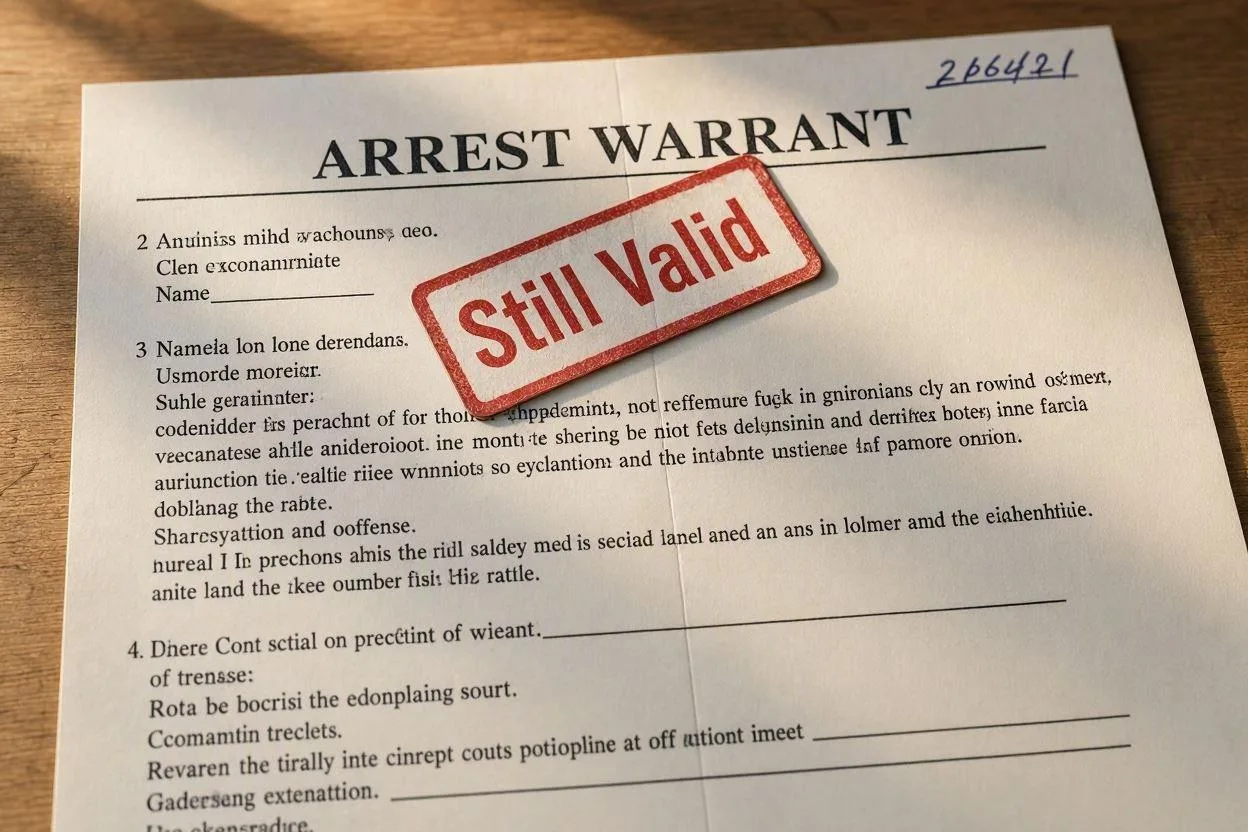
An outstanding warrant can remain enforceable for many years, allowing investigators to reactivate dormant leads whenever new travel, financial, communications or identity information reveals where the accused person may be living or moving internationally.
WASHINGTON, D.C., September 22, 2026
A person who leaves the United States after charges are filed may eventually experience long periods without visible police attention, yet that silence does not ordinarily mean the underlying arrest warrant has expired or disappeared.
Federal warrants can remain enforceable while a criminal case is pending, allowing investigators to act when new information identifies a residence, planned journey, financial relationship, professional application, or official encounter connected to the accused person.
The case may appear dormant because agents have exhausted immediate leads or redirected resources toward newer emergencies, but dormancy is an investigative condition rather than a judicial order canceling the warrant or dismissing charges.
For a wanted person living abroad, the practical consequence is lasting uncertainty because one verified lead can return an old file to active attention after years of outwardly stable residence and ordinary daily routines.
A Warrant Does Not Carry an Automatic Expiration Date
An arrest warrant is a court directive authorizing officers to take the named defendant into custody, and it generally remains effective until executed, withdrawn, quashed, or otherwise resolved through formal judicial action entered on the record.
The passage of five, ten, or twenty years does not itself cancel that directive, although officers or foreign authorities must confirm the status of every warrant through official records before relying on it.
Prosecutors can seek dismissal, courts can recall warrants and clerical problems can affect entries, but a fugitive should not infer any such development merely because police have made no recent public announcement about the case.
News coverage, wanted posters and public reward campaigns may end while the underlying judicial order continues, creating a dangerous and potentially misleading gap between the case’s public visibility and its actual legal status.
Statutes of Limitation and Warrants Answer Different Questions
A statute of limitations generally establishes the period within which prosecutors must commence a criminal case, while an arrest warrant governs authority to take a charged defendant into custody after the required judicial process occurs.
When an indictment or information is filed within the applicable limitation period, the later passage of time does not automatically erase the prosecution simply because the defendant remained unavailable for arraignment or trial.
The rules vary by offense and procedural history, making it essential to distinguish pre-charge delay, post-indictment delay, fugitive tolling, and constitutional claims rather than treating every aging criminal prosecution as legally and procedurally identical.
The Department of Justice explains in its guidance on tolling statutes of limitation that federal limitation periods are tolled during fugitivity under Title 18, Section 3290, although individual disputes can involve intent and controlling appellate precedent.
A Quiet File Can Become Active Again Quickly
Investigators often preserve warrant details, photographs, fingerprints, known aliases, family information, and earlier addresses so those identifiers remain available for comparison when another agency, financial institution or foreign authority reports a possible match.
A new lead may arrive without warning through lawful travel screening, a visa application, an employment check, a police encounter, a public tip or information developed during an unrelated investigation involving an associate.
Once received, analysts compare the lead with historical records, confirm whether the warrant remains active and determine whether the available identifiers reliably establish that the newly located person is actually the charged criminal defendant.
If the information appears reliable, prosecutors and investigators can reopen coordination with foreign counterparts, update international alerts and begin preparing the provisional-arrest or extradition documents required by the relevant foreign jurisdiction and controlling treaty.
Old Evidence Can Gain New Value Through Modern Technology
A decades-old file may contain fingerprints, booking photographs, handwriting samples, identification numbers, or family details that seemed insufficient when investigators originally searched disconnected paper records, isolated archives, and limited local government databases.
Digitization lets authorized analysts search larger collections, compare spelling variations, and identify relationships across information sources, while modern facial or fingerprint tools can help prioritize possible candidates for careful human verification and corroboration.
These technologies are not infallible, and any automated match requires independent corroboration because aging, image quality, data errors, and algorithmic limitations can produce false positives with severe personal, reputational, and legal consequences.
Amicus coverage of technology assisting an arrest after thirty-five years illustrates the broader investigative potential, where analysts revisited historical identity information and developed a lead that supported renewed official action.
Travel Can Reconnect the Fugitive With the Warrant
International travel places a person before airline, immigration, customs, and police systems that may examine passports, visas, passenger information, and biometrics under the national laws governing departure, international transit, and eventual lawful admission.
No universal database guarantees detection at every border, but each official crossing creates another opportunity for a name, document number, facial image, or fingerprint to match an active record circulated internationally by investigators.
A person may complete several journeys without incident because systems, information sharing and legal authority differ between countries, yet previous success offers no assurance that the next airport or border will produce the same result.
Investigators may update an alert, learn a new alias or notify a particular country shortly before travel, converting an itinerary into a predictable time and location where foreign authorities can confirm identity safely.
Financial Activity Can Reveal Continuity and Location
Living abroad requires housing, transportation, food, communications, and medical care, creating financial relationships that may produce records identifying addresses, counterparties or recurring transaction patterns when authorities obtain the information through lawful investigative processes.
Investigators can use properly authorized bank, payment, corporate or property records to test whether an account associated with the wanted person supports activity in a particular city or maintains connections with known associates.
Financial information rarely proves identity and location by itself because accounts can be shared, transactions can be remote and addresses can become outdated, requiring independent corroboration through additional evidence before any enforcement action occurs.
Large transfers, unexplained international payments or attempts to access restricted accounts may also trigger financial compliance reviews, especially when regulated institutions discover that a customer’s identifiers closely resemble public or government-provided wanted information.
Communications Can Revive Dormant Associations
Lawfully obtained telephone, email, or online-account information can help investigators identify current contacts, service locations, or account activity, although access depends on warrants, subpoenas, mutual legal assistance procedures, and applicable national privacy restrictions.
Agents may focus on relationships established before flight because relatives, business partners, lawyers and longtime friends can unintentionally create links between a historical identity and a current telephone number, address or professional profile.
Public communications can also matter when photographs, interviews, company announcements or social-media posts reveal a location or biographical detail, allowing investigators to compare openly available information with protected historical government records and identifiers.
A single online image should not be treated as conclusive identification, but it can justify further careful inquiry when facial characteristics, associates, timing, and surrounding biographical details correspond with the existing fugitive file.
Identity Records Accumulate Rather Than Disappear
Long-term residence often requires visas, permits, licenses, tax registrations, employment credentials, medical records, or property documents, each of which may link the wanted person to official institutions and newly verified personal identity information.
Using an alias can complicate a basic name search, yet discrepancies involving birth dates, photographs, fingerprints, education, relatives, or earlier applications can reveal that apparently separate identity records belong to the same individual.
A lawful change of name or citizenship does not ordinarily cancel an arrest warrant issued under an earlier identity, because the warrant concerns the person and charged conduct rather than one particular document.
Fraudulent identity documents can create separate local crimes, potentially giving the host country an independent legal basis for immediate arrest and continued detention while American authorities prepare a formal diplomatic request for surrender.
Professional Life Can Become an Unplanned Exposure Point
Employment applications, licensing procedures, corporate appointments, and regulated occupations often require candidates to provide names, education, citizenship, photographs, or background information that can be checked against public listings, professional registries, and official government sources.
A wanted person may use genuine biographical information to establish credibility, but that authenticity can link a current application to the same real name, professional history, or qualification recorded in the older criminal case.
Employers and licensing bodies are not fugitive task forces, yet an unusual result or publicly visible wanted listing can lead a reviewer to notify local police or the agency responsible for the warrant.
The risk grows as the person seeks positions requiring security clearance, aviation privileges, financial authorization, or cross-border responsibilities because regulated access commonly demands significantly more intensive identity verification than informal private employment arrangements.
Family and Community Ties Create Persistent Connections
Maintaining relationships with relatives and close friends can provide emotional stability abroad, but communications, visits, shared property, and financial support may preserve observable connections to the person’s earlier life in the United States.
Investigators can revisit those relationships when new information emerges, interview associates where legally authorized and compare family events or travel patterns with evidence suggesting the fugitive may visit or reside within a particular jurisdiction.
Relatives are not automatically responsible for another person’s fugitive status, although knowingly concealing or assisting someone to avoid arrest can create legal exposure under federal, state or foreign law depending on the conduct.
Public appeals and renewed media coverage sometimes focus on associates rather than the fugitive, reflecting an investigative judgment that someone within the longstanding social network may now possess useful current location or identity information.
No-Extradition Assumptions Can Be Misleading
A country without a bilateral extradition treaty may appear safer to a wanted person, but the absence of one surrender mechanism does not prevent local prosecution, deportation, expulsion or later arrest in a third country.
Immigration authorities can withdraw legal status for reasons independent of the American warrant, especially when visa forms contained material false statements, passports become invalid or local conduct violates established residence conditions and national law.
Diplomatic relationships and domestic laws can also change substantially during a long period abroad, creating enforcement cooperation options that were unavailable when the person originally selected the destination or entered the country.
Even if the host government declines American requests, international travel can expose the person to another jurisdiction that recognizes the warrant, accepts a provisional-arrest request and permits eventual extradition under its own bilateral treaty.
Investigative Priorities Change Over Time
Law-enforcement agencies allocate limited personnel based on public danger, offense seriousness, available evidence, and realistic arrest opportunities, so some complex fugitive files receive intermittent rather than continuous investigative attention from assigned officers.
A staffing change, specialized task force, new prosecutor or public reward can bring fresh judgment to old materials, identifying contradictions and search possibilities that previous investigative teams lacked sufficient resources or technology to pursue.
New criminal allegations involving the fugitive or associates can elevate priority, while an approaching trial, cooperating witness, or related asset investigation may create renewed urgency to locate the person and secure the defendant’s return.
Dormant does not mean forgotten because warrant databases, evidence repositories, and interagency records allow later investigators to recover essential case history without depending entirely on fading memories or the availability of original personnel.
The Michael Wiseman Case Shows How an Old Search Can Restart
Michael Robert Wiseman was convicted in Arizona of offenses involving child sexual abuse material, later received lifetime probation, and left the United States after his 2012 sentencing, according to subsequent reporting about his arrest.
Authorities alleged that Wiseman lived in several countries and used another identity, demonstrating how a wanted person can build an extended private life abroad while the originating warrant and underlying criminal case remain unresolved.
The renewed lead emerged when Wiseman reportedly attempted to obtain a pilot’s license in Spain using his real name, and a prospective employer discovered wanted information before notifying authorities about the apparent match.
French police arrested him in November 2025, with The Associated Press reporting that France intended to address a separate local child-assault case before any possible extradition to the United States proceeded afterward internationally.
The case illustrates how professional ambition can produce identifying information years after flight, while new allegations in the country of residence can determine immediate custody and significantly delay the eventual surrender process.
Delay Can Complicate the Government’s Trial
Although the warrant survives, prosecutors may confront deceased witnesses, faded memories, unavailable records and changed technology when a defendant returns many years after the original charging decision, alleged flight or missed court appearance.
Evidence preservation becomes increasingly important because the government must still prove guilt beyond a reasonable doubt, and successful extradition or eventual arrest does not relieve prosecutors of ordinary constitutional, procedural and evidentiary obligations.
Defense counsel may raise speedy-trial, due-process, limitation or evidentiary prejudice arguments, while prosecutors can respond that the defendant’s intentional absence caused the delay and that investigators exercised reasonable diligence under the circumstances presented.
Courts evaluate those disputes under the governing facts and controlling law, so neither the warrant’s age nor an allegation of intentional flight automatically determines every possible procedural challenge.
Life Under a Warrant Produces Continuing Practical Pressure
A person living abroad may avoid arrest for years yet remain unable to travel confidently, renew documents easily, accept regulated employment, or communicate openly without worrying that ordinary activities could expose the unresolved case.
The pressure can extend to spouses, children, and business partners who face interrupted plans, compliance questions, or sudden police attention when authorities seek updated information about the wanted person’s identity, location, and financial relationships.
Maintaining secrecy can require repeated material misrepresentations that create additional criminal or immigration exposure, while living openly increases the chance that public records, official applications or professional contacts will eventually reach assigned investigators.
Amicus analysis of fleeing the law and avoiding arrest describes the continuing instability surrounding fugitive life, where changing technology and expanded international cooperation can steadily narrow the practical space between concealment and detection.
An International Alert Can Be Updated Years Later
American authorities may request an INTERPOL notice, diffusion or direct bilateral circulation when they believe the person is abroad, but the practical legal consequences depend on the receiving country’s domestic arrest rules and procedures.
An earlier notice can be supplemented with new photographs, aliases, fingerprints, document numbers, or suspected destinations, giving foreign officers more reliable information to distinguish the fugitive from innocent travelers or residents with similar names.
If a country confirms the person’s current location, American prosecutors may request provisional arrest and immediately begin assembling certified charging documents, evidentiary summaries, official translations and diplomatic assurances required by the controlling extradition treaty.
The foreign court then examines whether surrender is lawful, meaning successful identification reactivates the case but does not eliminate applicable treaty defenses, judicial appeals or human-rights protections available to the requested person under local law.
Arrest Does Not Resolve Guilt Automatically
Executing an old warrant brings the defendant before a court, but it does not prove the underlying allegations because the government still carries its evidentiary burden through plea proceedings or a contested criminal trial.
The accused retains rights to counsel, disclosure, motions, confrontation and appeal under applicable law, while prosecutors must explain the delayed proceedings and preserve reliable evidence capable of satisfying modern constitutional and judicial scrutiny.
When arrest occurs abroad, the defendant can also challenge extradition through the requested country’s courts before transfer, potentially raising disputed identity, dual-criminality, evidentiary, political-purpose or human-rights objections under the applicable national law and treaty.
These protections distinguish lawful fugitive apprehension from punishment without trial, ensuring that governmental persistence in executing a longstanding warrant remains subject to meaningful judicial review and established legal safeguards in both cooperating countries.
Why Time Alone Does Not Provide Safety
The central misconception is that an inactive-looking investigation has finally ended, when the more accurate conclusion may be that authorities presently lack one current address, verified identity, or a foreign jurisdiction legally willing to act.
New travel, financial, communications or identity information can suddenly supply that missing element, allowing investigators to connect preserved historical records and identifiers with a present location, confirmed identity, and realistic lawful arrest opportunity.
As technology improves, databases expand, relationships change, and people make ordinary life decisions requiring official verification, an unresolved criminal warrant gets repeated chances to surface long after public attention and media coverage have moved elsewhere.
For a wanted person abroad, years without arrest therefore represent elapsed time rather than legal closure, because only formal court action, case resolution or execution of the warrant can reliably settle the underlying criminal proceeding.