

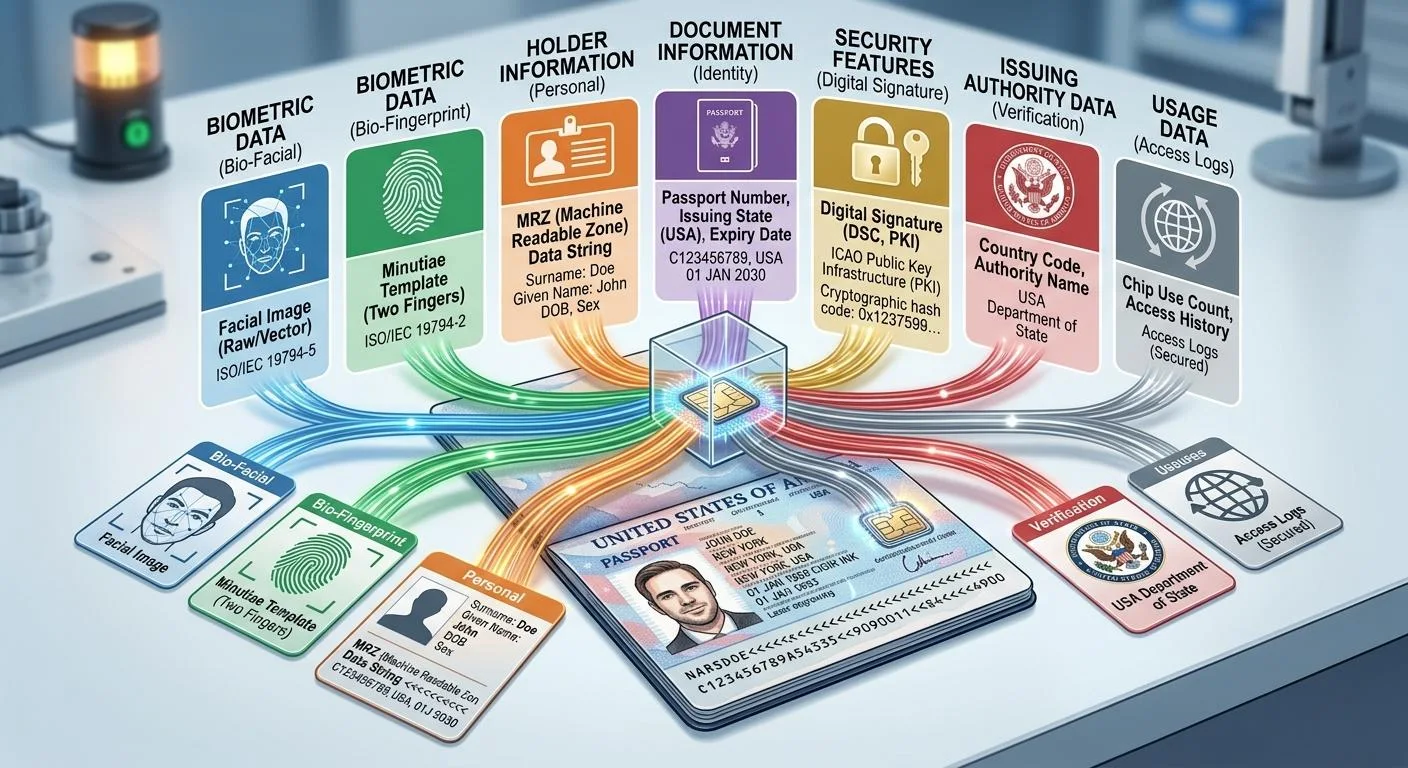
Digital biographical information and a facial image form the core of ePassport data, with additional biometric content varying by issuing country.
Washington, DC, October 19, 2026 — The electronic chip embedded in a modern biometric passport stores a structured digital version of key identity information, including biographical data and a facial image, while additional biometric information can vary based on the issuing authority’s policies and technical choices.
Although travelers sometimes imagine an electronic passport contains an extensive hidden government file, the chip is designed primarily as a secure travel-document component whose standardized information lets compatible inspection systems compare electronic data with the physical passport and the person presenting it.
The Chip Creates a Digital Companion to the Data Page
An electronic passport, commonly called an ePassport or biometric passport, contains a contactless integrated circuit embedded somewhere within the booklet, allowing authorized readers to communicate with the document without requiring exposed electrical contacts or inserting the chip into a conventional card reader.
This electronic component provides border authorities with standardized digital information that complements the visible data page, giving inspection systems another independent source to compare against key identity and document details.
The International Civil Aviation Organization’s machine-readable travel document standards define the international technical architecture governing these documents, establishing common structures that allow passports issued by different governments to remain interoperable at international borders.
Rather than storing information in an arbitrary arrangement chosen independently by every passport manufacturer, compliant electronic travel documents organize relevant information within a standardized logical structure so compatible inspection equipment can locate and interpret specific data categories.
Biographical Information Forms Part of the Core Record
The chip typically contains biographical information that closely matches the passport’s identity page, including the holder’s name, nationality, date of birth, sex, passport number, and document expiration information.
This information lets an inspection system compare what appears electronically with what is printed or otherwise personalized on the physical document, creating an important consistency check when authorities examine a passport at a border.
If someone altered visible biographical information without producing corresponding legitimate electronic information, the difference between the physical page and the chip could become a significant reason for additional examination by appropriately equipped authorities.
Correctly matching information provides useful evidence, but matching information alone does not establish complete passport authenticity because professional authentication also considers cryptographic signatures, physical security features, government records and the identity of the traveler presenting the document.
The Facial Image Is the Primary International Biometric
The digitally stored facial image represents the central biometric component of an interoperable ePassport, allowing border inspection systems to obtain a government-enrolled portrait directly from the electronic document rather than relying exclusively upon the photograph visible on the physical identity page.
That digital portrait can be displayed by compatible software or used by automated systems to compare the passport holder’s enrolled facial image with a live photograph captured at an electronic gate, kiosk or staffed border inspection point.
This process helps address a key question that document authentication alone cannot answer: authorities must determine not only whether the passport appears genuine, but also whether the person presenting it matches the identity represented in the document.
A properly authenticated chip containing a facial image therefore supports both document security and identity verification, although biometric comparison remains a separate analytical process from checking whether the chip’s stored data carries a valid governmental digital signature.
The Chip Uses Organized Data Groups
Electronic passport information is arranged into standardized data groups rather than stored as one undifferentiated block, allowing inspection systems to identify the category of information each part of the electronic record contains.
The biographical information corresponding to the machine-readable zone is stored separately from biometric information, while the facial image occupies the standardized biometric data group designated for interoperable face information within the electronic travel-document architecture.
This structure matters because border systems in different countries need a predictable way to find information, regardless of which participating government issued the passport being examined.
Standardization also allows passport technology to evolve while maintaining international compatibility, helping newer document generations operate within an established framework rather than requiring every receiving country to build entirely separate readers for every foreign passport design.
Fingerprints May Be Stored, but They Are Not Universal
Some issuing authorities place fingerprint information in electronic passports, providing an additional biometric identifier that can support specific national or regional identity-verification requirements.
Fingerprint information is not the same universally required, interoperable component as the facial image, so travelers should not assume every biometric passport contains fingerprints simply because the booklet displays the familiar electronic-passport symbol.
Whether fingerprints are enrolled, stored or accessible depends upon the issuing government’s legal framework, passport design and biometric policies, while access protections can also limit which inspection systems are permitted to retrieve particularly sensitive biometric information.
Consequently, two passports from different countries can both satisfy international ePassport requirements while containing different secondary biometric information beyond the standardized facial image used for international interoperability.
Iris Information Is Another Optional Biometric
The international electronic travel-document architecture can also accommodate iris biometric information, although governments may decide independently whether incorporating this additional identifier serves their passport issuance and border-management requirements.
Iris biometrics analyze distinctive patterns in the visible colored portion of the eye, offering another potential way to compare an enrolled biometric record with the person presenting a document.
As with fingerprint information, the technical standard’s ability to accommodate iris information does not mean every passport chip contains it, so issuing-country specifications are essential for determining exactly what biometric content should be present.
Variation among issuing authorities shows why electronic passports should be understood through their applicable specifications rather than through generalized assumptions about what every document must contain.
A Digital Signature Is Critical to Authentication
Stored names, photographs and passport numbers would provide limited protection if inspection systems had no reliable way to determine whether someone had improperly changed the electronic information after issuance.
For this reason, an ePassport contains cryptographic security information that lets compatible inspection systems evaluate the integrity and government origin of the protected data stored in the chip.
During an appropriate authentication process, the reader can verify the passport’s digitally signed information using the issuing authority’s public-key infrastructure, helping determine whether the protected chip contents have changed since legitimate document personalization.
This distinction matters because simply reading information from an electronic chip does not provide the same assurance as cryptographically validating the data against trusted information associated with the issuing government.
The Document Security Object Protects Stored Information
A key component within the electronic structure is the Document Security Object, which contains security information used during passive authentication to verify the integrity of protected data groups stored inside the passport.
Compatible systems can compare cryptographic hashes associated with individual data groups against the signed security object, allowing them to detect unauthorized changes to protected electronic information after the document was issued.
The security architecture therefore links the passport’s stored information to the government’s signing infrastructure rather than relying only on the presence of a functioning contactless chip.
This approach substantially strengthens electronic authentication because a copied collection of names and photographs is fundamentally different from data whose integrity can be validated through cryptographic credentials connected with a legitimate issuing authority.
Government Certificates Support Cross-Border Validation
To validate another country’s electronic passport, inspection authorities need reliable access to the public-key information associated with the foreign issuing authority.
The ICAO Public Key Directory facilitates the international exchange of certificate information that participating authorities need to validate digital signatures on electronic machine-readable travel documents.
This certificate infrastructure lets border authorities move beyond simply determining whether a chip responds to a reader, enabling compatible systems to verify whether the expected governmental trust structure signed the electronic information.
The distinction explains why a successful smartphone NFC connection and a professional cryptographic passport validation are not equivalent operations, even when both processes successfully display information retrieved from the same contactless chip.
Reading the Chip Is Not the Same as Authenticating It
A consumer smartphone application may successfully communicate with an ePassport chip and display the holder’s photograph, name or other stored information, demonstrating that compatible electronic data can be retrieved from the document.
That successful reading does not, by itself, establish that the passport was legitimately issued, because an authoritative electronic examination must also evaluate cryptographic security information and, where appropriate, compare the resulting information with trusted issuing-country credentials.
Similarly, an unsuccessful smartphone reading does not automatically prove that a passport lacks a functioning chip, because antenna positioning, software compatibility, protective covers, device hardware and physical passport condition can influence contactless communication.
Travelers interested in understanding how electronic checking fits within broader passport examination can review the Amicus International Consulting explanation of modern passport security and counterfeit detection, which describes how chip checks and physical inspection complement one another.
The Digital Portrait Is Separate From the Phone’s Camera Image
When a passport-reading application displays two facial images, travelers may mistake them for duplicate photographs from the same source, even though the images can come from different stages of the electronic verification process.
One image can come directly from the passport chip as the government-enrolled facial record, while another can come from the smartphone camera or inspection system as a newly captured live image of the person presenting the document.
Software can compare those images to estimate facial similarity, but that biometric comparison should be distinguished from cryptographic authentication because the two processes address separate security questions.
Cryptographic checking evaluates whether protected electronic passport information remains authentic and intact, while facial comparison evaluates whether the person currently presenting the document resembles the individual represented by the enrolled portrait.
The Chip Does Not Normally Function as a Travel-History Diary
A common misconception suggests that every border crossing automatically writes a detailed list of destinations, immigration decisions, and travel movements directly onto the passport chip, creating a complete international movement history inside the booklet.
The standardized core function of an ePassport chip instead centers on identity, biometric, and document-security information, while governments generally maintain entry, exit, and immigration records in their own border-management systems rather than continuously rewriting the passport’s protected identity data.
Border authorities can therefore obtain information from external immigration databases not stored in the passport chip itself, creating an important distinction between information physically carried by the traveler and information maintained in government systems.
Understanding that distinction helps explain why scanning an ePassport with a consumer application usually doesn’t reveal the full set of travel and immigration information that border agencies may hold separately.
The Chip Is Not a GPS Tracking Device
Another widespread misunderstanding concerns the passport chip’s contactless nature, which can lead travelers to imagine the booklet continuously broadcasts its location or functions like a cellular tracking device.
An ePassport chip is a short-range, contactless component that communicates only when properly energized and accessed by compatible reading equipment, not an independently powered transmitter that constantly reports the holder’s location.
The technology therefore performs a substantially different function from a mobile telephone, satellite tracker, or internet-connected device because the passport chip primarily stores information for controlled, short-range retrieval during document examination.
Security protocols and access mechanisms also reduce unauthorized interaction with the electronic document, although exact protections can vary depending on passport generation and the technology implemented by the issuing authority.
Access Controls Protect Electronic Information
Electronic passports incorporate mechanisms intended to regulate access to stored information, preventing the chip from functioning like an unrestricted memory device that any nearby reader can freely browse without establishing appropriate communication conditions.
Depending on the passport generation and issuing authority, access protocols can use information from the physical document or stronger cryptographic techniques before allowing specific electronic communication to proceed.
When implemented, more sensitive secondary biometric information can receive stronger access protections than ordinary biographical information because fingerprints and similar records create additional privacy considerations for issuing and inspecting authorities.
These controls show that ePassport security depends not only on what information the chip stores but also on how readers grant access and how inspection systems authenticate the information they retrieve.
Chip Capacity Does Not Mean Every Available Field Is Used
The standardized electronic structure supports numerous data groups and technical elements, but an available storage location does not mean every issuing country populates every possible category.
Passport authorities select information based on international requirements, domestic law, document design, and operational objectives, creating legitimate differences between passports from different countries.
A traveler examining one passport might therefore encounter information that does not appear in another country’s document, even though both passports remain interoperable within the international electronic travel-document framework.
Professional inspection depends upon knowing what the specific issuing authority and passport generation are expected to contain rather than treating one country’s configuration as a universal template.
Physical and Electronic Information Should Reinforce One Another
One of the strongest security benefits of an ePassport comes from the ability to compare electronically stored information with corresponding details physically printed on the passport data page.
If the visible photograph, name, document number or other major information conflicts with authenticated chip data, authorities have an immediate reason to investigate whether the physical document has been altered or improperly reconstructed.
Conversely, consistent physical and electronic information can strengthen confidence, particularly when the chip’s digital signature also validates successfully against trusted issuing-country certificate information.
This comparison shows why electronic passports remain both physical security documents and digital credentials, because authorities should not evaluate the booklet and the chip entirely independently when authentication is required.
Chip Authentication Does Not Replace Physical Inspection
Even a successfully authenticated chip cannot establish that every page, stitch, hologram or physical component within a passport booklet remains untouched, making direct document inspection an important part of comprehensive examination.
Authorities may still evaluate polycarbonate construction, laser personalization, holographic features, ultraviolet designs, security paper, and binding when circumstances require closer examination of the physical document.
Likewise, an impressive physical passport should not automatically be accepted as electronically authentic if its chip information fails expected validation or conflicts substantially with visible personalization.
Modern passport security relies on this overlap, forcing fraudulent documents to remain convincing across multiple independent physical, biometric, and cryptographic systems rather than satisfying only one superficial check.
Electronic Passports Carry Identity Information, Not Unlimited Personal Records
The most useful way to understand an ePassport chip is to view it as a specialized secure identity component rather than as a miniature database containing every record associated with the passport holder.
Its core information links the document to its holder through standardized biographical data and a facial image, while optional secondary biometrics and cryptographic structures can add identity and authentication capabilities.
The exact configuration can vary among issuing authorities, particularly regarding fingerprints, iris information and access-control technologies, making country-specific documentation important whenever detailed technical conclusions are required.
For ordinary travelers, the key point is that electronic passport technology strengthens the link between the physical document, its digitally protected identity information, and the person presenting it at an international border.
When physical security features, authenticated electronic data and biometric comparison all support the same identity, authorities gain a substantially stronger basis for document verification than would be available from a printed photograph and passport number alone.