

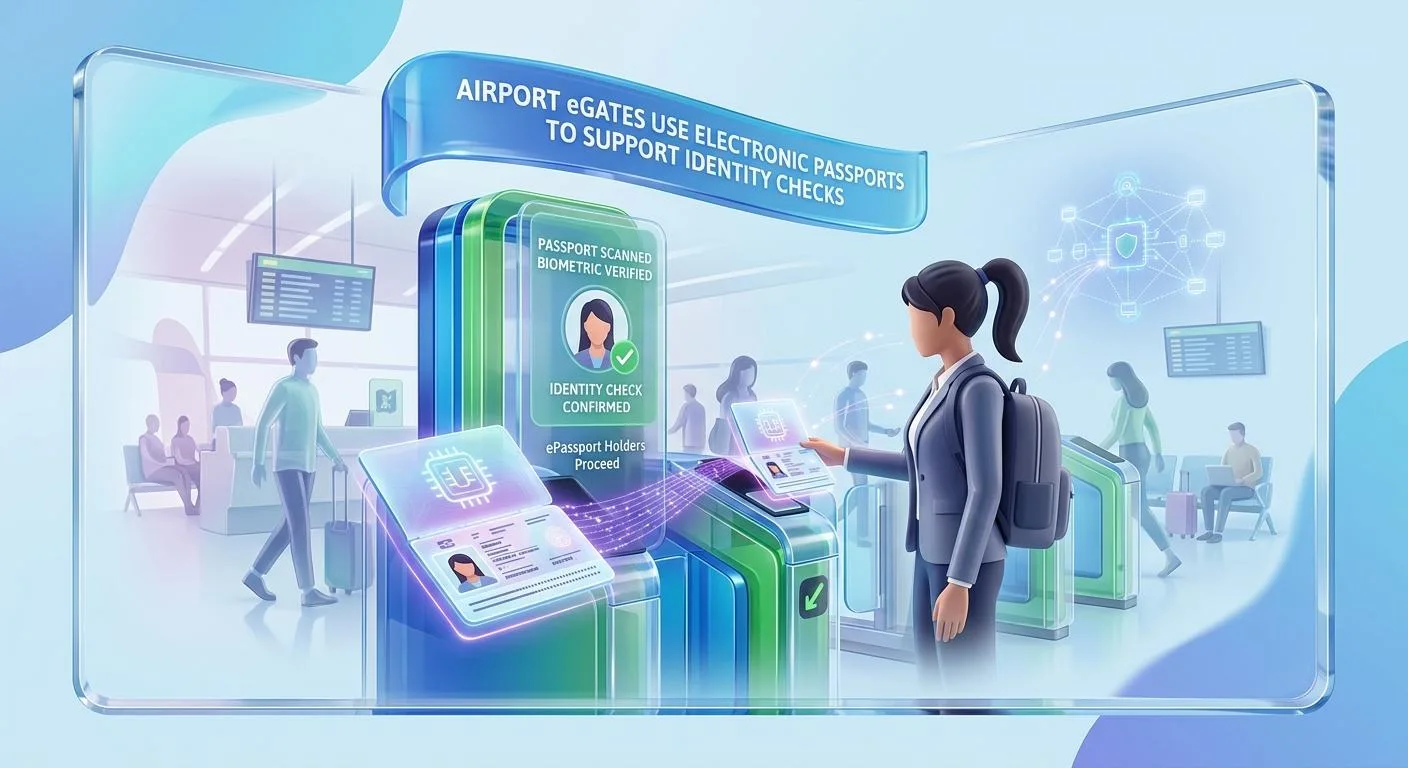
Protocols such as PACE help establish protected communications between compatible travel documents and inspection equipment.
WASHINGTON, DC, October 15, 2026 — European electronic passports demonstrate how contactless identity technology can support rapid border processing without treating the passport chip as unrestricted wireless storage, because modern access-control protocols require compatible inspection equipment to establish protected communication before retrieving sensitive electronic information.
Protocols such as Password Authenticated Connection Establishment, commonly known as PACE, strengthen this process by creating encrypted and integrity-protected communication between compatible travel documents and inspection systems, reducing opportunities for unauthorized reading or interception while preserving international interoperability.
Why Contactless Passport Chips Need Access Controls
Electronic passports contain contactless integrated circuits that can store standardized identity information and biometric data, allowing compatible inspection equipment to retrieve information much more efficiently than border officers could through manual data entry alone.
However, wireless communication creates an important privacy challenge because identity information should not become freely accessible just because an unknown device can generate a radio-frequency field near the passport’s contactless component.
Secure access protocols address this challenge by requiring the reader and passport to complete defined cryptographic procedures before the document allows ordinary electronic communication with protected information stored in its chip.
European Passports Developed Within a Strong Biometric Framework
European Union passport standards have progressively incorporated electronic biometric information and strengthened technical protections surrounding access to that information, reflecting broader efforts to combine reliable traveler identification with safeguards against document fraud and unauthorized electronic access.
European technical frameworks have also supported Extended Access Control and PACE implementations for machine-readable travel documents, demonstrating how electronic identity security increasingly depends upon both protecting stored information and controlling the systems permitted to retrieve particularly sensitive biometric data.
The broader European Commission travel-document framework shows how document verification, biometric technology, and increasingly digital border systems work together within the Schengen environment rather than as isolated technical components.
PACE Strengthens the Initial Electronic Connection
PACE lets a passport chip and compatible reader use document-associated information in a cryptographic exchange that creates strong session keys before ordinary protected data communication begins.
The resulting connection helps prevent the passport from behaving like an openly readable NFC device, because compatible equipment must participate in the required security exchange rather than simply requesting personal data immediately after detecting the chip.
This controlled approach helps protect confidentiality while still allowing legitimate border equipment to process electronic passports efficiently when travelers intentionally present their documents during immigration, airline, or authorized identity-verification procedures.
PACE Improves Upon Earlier Access Technology
Earlier electronic passport generations commonly relied on Basic Access Control (BAC), an important improvement over unrestricted chip access, but it provided weaker protection against certain interception and password-guessing scenarios than later protocols.
PACE was developed to provide stronger password-authenticated key establishment and improved protection for subsequent communication, allowing passport systems to strengthen confidentiality without abandoning the international interoperability necessary for documents used across numerous national border environments.
The continuing transition toward stronger access-control technology reflects the normal evolution of cryptographic systems, where techniques considered adequate during early electronic passport deployments gradually give way to more robust mechanisms as standards, computing capabilities, and security research advance.
The Machine-Readable Zone Can Help Establish Access
Information printed inside the passport can support electronic access procedures by linking possession of the physical document to the reader’s ability to communicate with the embedded contactless chip.
The machine-readable zone contains standardized identity and document information, and selected data from this area can be used to derive the information required for access-control procedures supported by electronic machine-readable travel documents.
This arrangement creates an additional obstacle to casual, unauthorized reading because merely detecting a nearby NFC chip does not necessarily provide everything needed to establish the expected protected communication session.
The MRZ Is Not Simply a Conventional Password
Travelers should not think of the machine-readable zone as a secret password chosen by the passport holder, because its contents follow internationally standardized structures and remain visibly printed on the identity page.
Its security role instead comes from requiring an electronic reader to possess appropriate document information before establishing communication, linking chip access more closely to intentional presentation or physical examination of the passport.
Newer access-control approaches strengthen that relationship through cryptographic exchanges that derive protected session information without treating the visible MRZ characters themselves as sufficient long-term encryption credentials.
Secure Messaging Protects Information After Access
Initial access is only the first stage, because information exchanged afterward should remain protected while traveling wirelessly between the passport chip and inspection terminal.
PACE establishes cryptographic session keys to support secure messaging, so subsequent communications receive confidentiality and integrity protections rather than transmitting sensitive passport information openly over the contactless connection.
This helps address eavesdropping risks because an outside observer attempting to intercept radio-frequency traffic should encounter cryptographically protected exchanges rather than straightforward personal information that can simply be read from captured communications.
Protection Against Skimming Is an Important Objective
Electronic passport security designers have long considered skimming, where an unauthorized reader tries to access a contactless document without the holder deliberately presenting it, an important privacy concern that requires technical safeguards.
Access controls make this substantially harder than with completely unrestricted electronic storage, because the unknown reader must satisfy protocol requirements before the passport provides access to protected information.
No security system should be described as absolutely invulnerable, but requiring cryptographic access procedures creates a significantly stronger barrier than allowing every technically compatible NFC device to retrieve identity information immediately.
Eavesdropping Presents a Different Security Problem
Skimming involves unauthorized interaction with the passport itself, whereas eavesdropping involves observing communication already occurring between the passport and a legitimate inspection system, meaning the two threats require related but distinct protections.
Encrypted secure messaging helps address the second threat by protecting information transmitted after the chip and authorized reader establish their session, making intercepted radio traffic substantially less useful without possession of the appropriate session keys.
This distinction shows why passport security cannot rely solely on preventing unknown readers from initiating access, because legitimate wireless communication also requires protection as personal information travels between trusted devices.
PACE Does Not Authenticate the Entire Passport
Successfully completing PACE shows that the reader and chip established the protected communication required for that passport generation, but it does not independently prove that every physical and electronic characteristic of the passport is authentic.
Digital signature verification serves a different role by helping determine whether protected data matches information originally signed by a trusted issuing authority, while physical inspection evaluates materials, personalization, booklet construction, and other tangible security characteristics.
A professional border system therefore proceeds through several complementary stages rather than treating successful access control as complete authentication of the travel document or the individual presenting it.
Digital Signatures and Access Control Solve Different Problems
Access control primarily addresses who can communicate with the electronic passport and how that communication remains protected, while digital signatures address whether retrieved information retains the integrity associated with trusted government issuance.
Keeping those concepts separate prevents the common misunderstanding that successfully reading protected chip information proves the data is cryptographically authenticated and remains associated with a currently valid passport.
Strong border inspection requires both secure access and reliable authentication because confidentiality and authenticity are different security requirements even when the same electronic document supports both functions.
European Passports Can Protect Fingerprints More Strictly
European electronic passport systems have historically provided stronger controls over access to fingerprint information than facial-image retrieval, reflecting the greater sensitivity of certain biometric identifiers stored in electronic travel documents.
Extended Access Control frameworks can require inspection terminals to prove additional authorization before accessing protected biometric information, meaning possession of technically compatible NFC hardware does not automatically grant identical access to every data category stored on the chip.
This architecture shows how electronic passports can assign different security requirements to different information, rather than treating all stored data as equally sensitive or subject to the same access conditions.
Terminal Authentication Adds Another Authorization Layer
Where stronger biometric protection applies, inspection equipment may need to present cryptographic credentials showing it is authorized to retrieve protected information from the travel document.
The passport can evaluate those credentials before releasing restricted biometric data, creating a security model in which access rights depend not merely upon technical compatibility but also upon whether the inspection system can demonstrate trusted authorization.
This approach lets governments distribute electronic passports internationally while retaining stronger controls over particularly sensitive biometric information that shouldn’t be accessible to every organization that can read standard passport data.
Not Every European Passport Is Technically Identical
Europe contains numerous sovereign issuing authorities, and passport generations introduced at different times can use different chip technologies, cryptographic suites, access protocols, physical materials, and biometric implementations while remaining legitimate international travel documents.
Border equipment must therefore support a range of document generations rather than assuming every European electronic passport follows an identical implementation, especially because passports can remain valid for many years after newer technologies enter production.
Professional inspection depends upon recognizing the specific passport model and its expected technical characteristics before interpreting differences in electronic behavior as evidence of a problem.
Older and Newer Security Protocols Can Coexist
Long passport validity periods mean older electronic documents can remain in circulation alongside newer generations that support stronger cryptographic mechanisms, creating transitional periods when border infrastructure must correctly process both technologies.
This coexistence does not mean older passports are automatically fraudulent or unusable, because legitimately issued travel documents generally remain acceptable throughout their validity unless the issuing government cancels them or another legal circumstance intervenes.
Border authorities face the challenge of maintaining compatibility while progressively strengthening the technical standards required for newly issued electronic documents.
European Certification Continues to Recognize PACE
European cybersecurity certification materials published during 2026 continue to reference protection profiles for machine-readable travel documents using standard inspection procedures with PACE and Extended Access Control configurations incorporating PACE, demonstrating the protocol’s continuing relevance within European secure-document technology.
This ongoing technical recognition shows that secure passport access extends beyond theoretical standards and remains part of contemporary certification frameworks applied to security products that support highly protected identification and travel-document environments.
Certification does not make every implementation identical, but it provides structured methods to evaluate whether security components meet defined technical protection profiles under recognized assessment procedures.
Secure Chip Access Supports Automated Borders
European border systems increasingly rely on electronic identity information and biometrics, making reliable communication with electronic travel documents particularly important as automated inspection becomes more deeply integrated into external-border procedures.
The European Union’s Entry/Exit System became fully operational across participating external border crossing points on April 10, 2026, replacing manual passport stamping for covered short-stay non-EU travelers with electronic registration incorporating travel-document information and biometric data.
Reliable passport-chip access becomes increasingly valuable within such environments because digitally retrieved identity information can support automated workflows while remaining only one component within much broader immigration, biometric, and security procedures.
The Chip Does Not Make Immigration Decisions
An electronic passport chip does not decide whether someone may enter the Schengen area, calculate immigration eligibility independently, or determine whether the traveler satisfies legal conditions imposed by individual governments or European border rules.
Instead, the chip supplies protected identity information that authorized inspection systems can use while separate immigration databases, biometric processes, visa records, and border-control rules determine how authorities evaluate the traveler.
This distinction prevents the passport’s technical security mechanisms from being confused with the legal and administrative systems that ultimately govern admission, refusal, and immigration status.
A Secure Connection Does Not Establish Current Passport Status
A document can establish protected electronic communication successfully while still having been reported lost, stolen, revoked, canceled, or otherwise invalid after its original issuance, because those subsequent events do not necessarily change the chip’s access-control behavior.
Border authorities therefore require separate status checks to determine whether a legitimately manufactured passport remains acceptable for travel when someone presents it.
Electronic access, cryptographic authenticity, biometric identity, and current government status answer different questions, which explains why sophisticated border systems evaluate several sources rather than expecting the NFC component to provide one universal authenticity result.
Physical Passport Security Remains Essential
European electronic passports continue to use sophisticated physical protections because access-control technology cannot independently detect page substitution, altered laser engraving, damaged holograms, reconstructed booklet binding, incorrect security printing, or other forms of physical document manipulation.
An authentic electronic component placed in an altered or suspicious physical booklet can still require secondary examination, just as a visually convincing passport can still raise problems when authorities evaluate its electronic data.
Physical and electronic technologies therefore reinforce one another because they protect different parts of the document and expose different categories of potential fraud.
Smartphones Can Demonstrate the Access Process
Modern NFC-enabled smartphones can communicate with many electronic passports when compatible software first captures or receives information required to complete the document’s supported access-control procedures.
The process shows why simply placing an ordinary phone near a closed passport doesn’t necessarily provide immediate access to all stored identity information, because specialized software must understand and complete the required protocol exchange.
Consumer applications can make this technology easier to understand, but their capabilities should never be confused with the full certificate infrastructure, biometric systems, government databases, and specialist document tools available to official border agencies.
Failed Electronic Access Does Not Automatically Prove Fraud
A passport reader can fail because of incorrect machine-readable information, antenna damage, poor NFC positioning, software incompatibility, unsupported cryptographic protocols, electronic component failure, or several other technical conditions unrelated to deliberate counterfeiting.
A failed PACE or other access procedure therefore requires context before anyone concludes that the document itself is fraudulent, particularly when consumer applications rather than official inspection equipment produce the result.
Travelers experiencing persistent electronic problems should seek guidance from the passport’s issuing authority rather than attempting physical repairs or assuming that one unsuccessful smartphone scan definitively determines authenticity.
Digital Travel Credentials Increase the Importance of Trusted Data
The European Commission has proposed broader use of digital travel credentials based on information stored within passports and identity cards, including facial images while excluding fingerprints from the proposed digital credential structure.
As identity information becomes more widely used in digital border workflows, it becomes even more important to ensure that source travel documents are accessed securely and electronically authenticated, because later digital processes depend on confidence in the information extracted from those original credentials.
This evolution does not eliminate physical passports immediately, but it shows how technologies originally developed for secure chip-based documents can become increasingly important in broader digital identity systems.
Privacy and Interoperability Must Work Together
European passports must work at inspection points across numerous countries while protecting sensitive information from unnecessary exposure, creating a technical challenge that requires security controls without sacrificing reliable international interoperability.
PACE addresses part of that challenge by letting compatible readers and passports establish protected communication through standardized cryptographic procedures, rather than requiring every country to invent an incompatible proprietary access system.
Common standards therefore support both mobility and privacy because the same travel document can function internationally while retaining controlled electronic access based on recognized technical procedures.
Cryptographic Security Must Continue Evolving
Electronic passport technology cannot remain fixed because cryptographic research, computing capabilities, attack techniques, and security expectations keep evolving long after individual passport generations enter circulation.
The shift from earlier mechanisms to stronger protocols such as PACE shows how issuing authorities and international standards bodies can improve communication security while maintaining compatibility with established border-processing requirements.
The long operational life of passports makes these transitions especially important because security systems must support current travelers while gradually raising protection requirements for future documents.
Secure Access Is the Gateway to Electronic Verification
Before an inspection system can evaluate digital signatures, compare electronically stored facial images, or perform other chip-based procedures, it must first establish the communication permitted by the passport’s access-control architecture.
That makes secure access a foundational electronic step, even though it does not independently authenticate every aspect of the document or establish the traveler’s legal entitlement to cross a border.
Through Amicus International Consulting’s passport security resource, readers can examine how controlled chip access fits alongside digital signatures, biometric comparison, polycarbonate construction, optical devices, ultraviolet protections, microprinting, and other elements within modern passport security.
European ePassports Show Why the Connection Matters
European electronic passports show that protecting personal information requires attention not only to what governments store in a chip but also to how inspection equipment accesses that information when travelers present their documents.
PACE strengthens that connection by creating a cryptographically protected communication channel, while additional authentication and authorization mechanisms address separate questions involving data integrity, sensitive biometrics, physical document security, and legitimate government use.
The result is a travel-document environment in which secure chip access functions as an essential gateway rather than a complete authentication system, allowing electronic identity information to support efficient border inspection without turning the passport into unrestricted contactless storage.