
Federal prosecutors say his lab businesses submitted false Medicare claims for unnecessary COVID-19 and respiratory tests.
WASHINGTON, DC, September 3, 2026 — Patrick Britton-Harr is preparing for a second federal trial in Maryland, where prosecutors allege his laboratory businesses exploited emergency demand for COVID-19 screening to bill Medicare millions of dollars for unnecessary, unauthorized, or fabricated respiratory testing.
The healthcare prosecution remains legally separate from the AeroVanti wire fraud case that produced six convictions, requiring the government to establish a different alleged scheme through medical records, laboratory data, Medicare claims, financial transactions, and testimony from healthcare participants.
Federal prosecutors have charged Britton-Harr with five counts of healthcare fraud and one count of money laundering, while published scheduling information places the Baltimore trial on October 13, subject to later orders from the federal court.
The indictment alleges that Britton-Harr used Provista Health to submit more than $15 million in claims for respiratory pathogen panel testing and received more than $5 million from Medicare despite alleged deficiencies affecting necessity, physician authorization, performance, and beneficiary eligibility.
Britton-Harr has not been convicted in the healthcare prosecution, and the government must prove every criminal charge beyond a reasonable doubt without treating the AeroVanti verdict or an earlier civil judgment as automatic proof of criminal liability.
The separate indictment focuses on pandemic laboratory billing
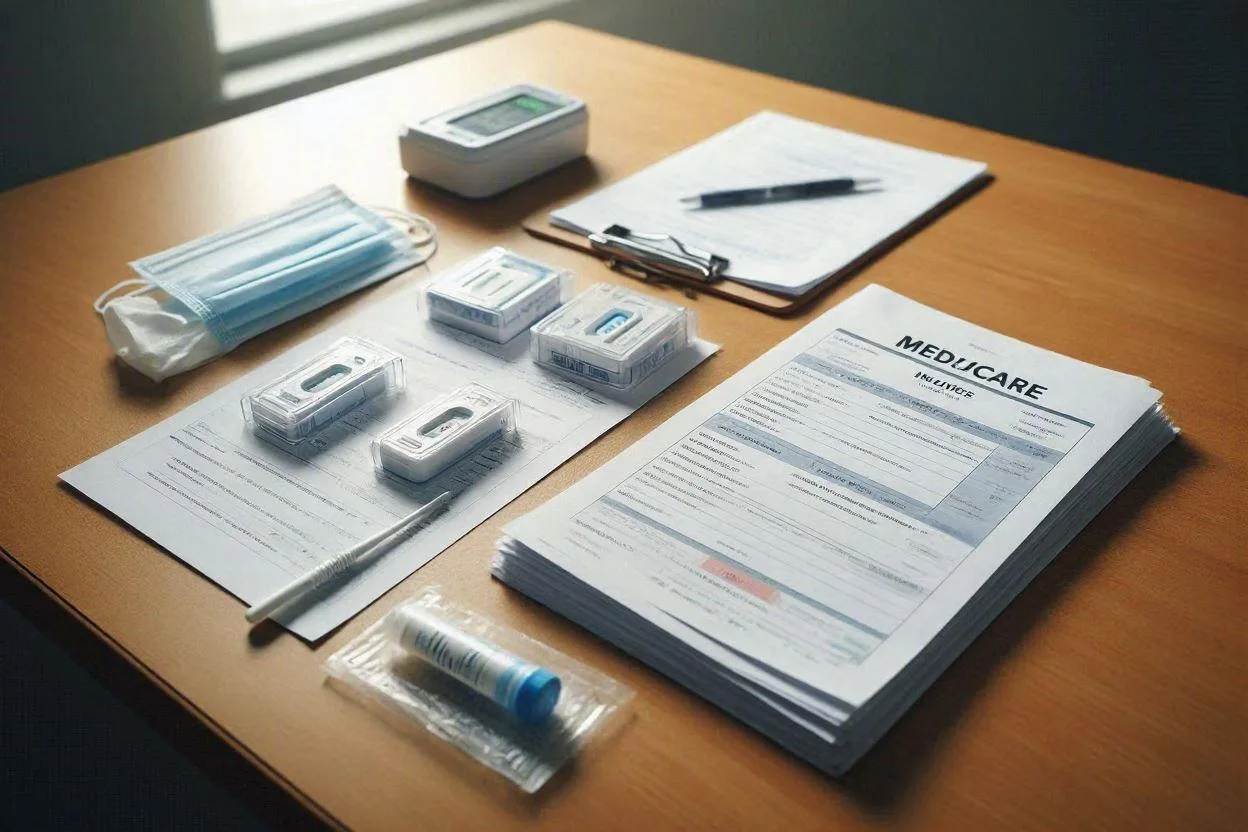
According to the Justice Department’s description of the criminal allegations, Britton-Harr offered COVID-19 screening to nursing home patients nationwide before allegedly billing Medicare through Provista Health for substantially more expensive respiratory pathogen panel tests.
Respiratory pathogen panels can test a patient sample for numerous viral and bacterial organisms, but Medicare reimbursement ordinarily depends upon the service being reasonable, medically necessary, supported by a valid order, and actually performed for the identified beneficiary.
Prosecutors contend that the disputed panels failed those requirements because patients did not medically need them, treating physicians had not ordered them as required, and many billed tests were never completed despite claims representing otherwise.
The indictment also alleges that some claims concerned people who had already died, an accusation likely to become especially important because dates of death, specimen collection, laboratory processing, and claim submission can be compared through objective records.
The criminal trial will therefore examine more than whether laboratories possessed equipment capable of conducting respiratory testing, because prosecutors must connect particular claims and financial movements to Britton-Harr’s alleged knowledge, decisions, and intent during the charged period.
COVID-19 screening allegedly opened the door to broader panels
During the pandemic’s early stages, nursing homes faced extraordinary pressure to protect older and medically fragile residents, creating urgent demand for reliable COVID-19 testing as facilities confronted outbreaks, shortages, regulatory requirements, and rapidly changing public-health guidance.
The government’s theory is that Britton-Harr’s businesses used that legitimate demand as an entry point, offering screening services while allegedly attaching or generating broader respiratory panels that produced significantly greater Medicare reimbursement than COVID-19 testing alone.
That distinction matters because a facility’s desire for coronavirus screening would not automatically establish medical necessity for testing individual residents against a large collection of other respiratory pathogens, particularly when patients lacked symptoms supporting those additional services.
Prosecutors must show how nursing homes were solicited, what services administrators believed they were accepting, how samples were obtained, what ordering information accompanied them, and which billing codes eventually reached Medicare contractors.
The defense can challenge whether pandemic conditions reasonably supported broader testing, whether clinical protocols authorized particular panels, whether responsibility rested with physicians or laboratory personnel, and whether Britton-Harr personally understood the details behind individual claim submissions.
Medical necessity will become a central factual dispute
Healthcare fraud does not arise merely because a test later appears excessive or because another clinician might have selected a narrower panel, since criminal liability requires proof of a knowing scheme rather than retrospective disagreement over medical judgment.
Prosecutors must therefore demonstrate that the disputed testing lacked legitimate diagnostic justification and that Britton-Harr knowingly participated in representations capable of influencing Medicare’s decision to pay, rather than relying upon ordinary mistakes or ambiguous pandemic-era practices.
Patient charts, reported symptoms, facility records, physician orders, requisition forms, laboratory results, and billing codes can show whether respiratory panels matched clinical conditions, although both sides may interpret incomplete or quickly created records differently.
Expert witnesses could explain when broad respiratory panels are appropriate, why testing uncommon pathogens may be unnecessary for asymptomatic residents, and how accepted laboratory practices differed from the system prosecutors attribute to Britton-Harr’s companies.
Defense experts may identify circumstances in which overlapping respiratory symptoms, outbreak control, vulnerable populations, or uncertain coronavirus presentation justified expanded testing, potentially narrowing the number of claims prosecutors can confidently characterize as fraudulent.
The jury must ultimately separate questionable utilization from intentional deception, ensuring that allegations about aggressive billing do not replace the statutory requirement that Britton-Harr knowingly executed or attempted to execute a scheme against a federal healthcare program.
Physician orders provide another evidentiary pathway
Medicare laboratory claims ordinarily require valid medical orders supporting covered services, giving prosecutors a documentary method for testing whether physicians actually requested the panels that Provista Health allegedly performed and billed during the pandemic.
The government can compare electronic health records, physician signatures, requisitions, communications, and laboratory information systems, looking for panels lacking any corresponding order or carrying documentation created after samples and claims had already moved through processing.
Physicians and nursing home employees may testify about whether they authorized respiratory panels, understood the scope of requested testing, received results, or were asked to approve forms that did not reflect their contemporaneous clinical decisions.
Britton-Harr’s defense can question witnesses’ memories several years after a chaotic health emergency, identify informal ordering practices, and argue that administrative omissions do not necessarily establish that laboratory executives deliberately manufactured authorization for Medicare payment.
The ownership and management structure will also matter because prosecutors must connect corporate billing failures to Britton-Harr individually, establishing more than his title or financial interest in businesses employing laboratory, sales, compliance, and reimbursement personnel.
Claims for tests allegedly never performed raise a sharper question
Although medical necessity can produce expert disagreement, a claim for a test that was never performed presents a more direct factual conflict, because Medicare reimbursement assumes the identified laboratory service occurred for the listed beneficiary.
Prosecutors can examine machine logs, accession records, reagent use, result reports, sample-tracking systems, technician schedules, and claims files to determine whether billed panels left the operational evidence ordinarily generated by completed laboratory work.
The allegation involving deceased beneficiaries could allow the government to place death records beside claimed collection dates, asking jurors whether any legitimate explanation exists when documentation represents that a specimen was obtained after the patient died.
The earlier civil complaint alleged hundreds of claims containing post-death specimen dates, but the criminal jury must evaluate the evidence admitted in this prosecution rather than simply adopting allegations or findings from separate proceedings.
The defense may explore data-entry mistakes, delayed billing, corrected claims, beneficiary-identification errors, system migrations, or inaccurate death information, while prosecutors will try to show patterns too consistent and extensive to reflect innocent clerical failures.
The dollar figures establish scale without independently proving fraud
The indictment attributes more than $15 million in submitted respiratory-panel claims and over $5 million in Medicare payments to the alleged operation, figures that describe potential loss while leaving intent and claim-level falsity for trial.
Large totals can make a prosecution appear overwhelming, but jurors must still determine whether the government has proven the charged executions, connected them to Britton-Harr, and excluded reasonable explanations grounded in clinical care or administrative error.
Prosecutors will likely organize thousands of underlying transactions through summary witnesses, representative claims, financial spreadsheets, and expert analysis, enabling jurors to understand an alleged national billing pattern without reviewing every patient record individually.
The defense can challenge whether selected examples fairly represent the broader universe, whether extrapolation obscures legitimate claims, and whether payment amounts include services that Medicare would have reimbursed even if certain documentation had been handled differently.
Medicare’s decision to pay a submitted claim does not itself prove that the claim was proper, while a later denial or recoupment does not automatically establish criminal intent by every executive associated with the billing supplier.
The money laundering count follows the alleged proceeds
Alongside five healthcare fraud counts, prosecutors charged one money-laundering count, requiring proof of a financial transaction involving property derived from specified unlawful activity and the additional statutory elements applicable to the charged transfer.
Bank records can show where Medicare reimbursements entered corporate accounts, how funds moved among related entities, who authorized transfers, and whether money allegedly traceable to fraudulent claims supported personal expenditures or other business activity.
The defense can dispute tracing, argue that commingled accounts contained legitimate revenue, challenge whether Britton-Harr knew particular funds represented criminal proceeds, and contest the government’s interpretation of transactions carrying ordinary commercial explanations in the ordinary course.
Each healthcare fraud and money laundering count carries a maximum statutory sentence of ten years, although any punishment after conviction would depend upon federal sentencing guidelines, proven loss, criminal history, judicial findings, and other statutory considerations.
Those maximums are not predictions, and the sentencing exposure from the separate AeroVanti convictions cannot be added mechanically without considering how federal courts address concurrent or consecutive punishment, related conduct, and final judgments.
The civil judgment and criminal indictment serve different purposes
Before the criminal indictment, the government pursued a False Claims Act lawsuit against Britton-Harr and several laboratory businesses, alleging more than 24,000 false claims covering over 300,000 respiratory pathogen panel tests during the pandemic.
The government later obtained a default judgment exceeding $26 million against Britton-Harr and Provista Health, but a default civil liability judgment does not eliminate the criminal presumption of innocence or reduce the prosecution’s burden of proof beyond a reasonable doubt.
Civil False Claims Act cases address government losses, statutory penalties, and treble damages under different procedural and evidentiary standards, whereas a criminal healthcare fraud prosecution determines personal guilt and potential imprisonment through a unanimous jury verdict.
Prosecutors may seek admission of underlying business records or statements from the civil dispute when permitted, while defense lawyers can argue that defaults, sanctions, and judicial conclusions from that proceeding would unfairly prejudice the criminal jury.
The trial court must manage that boundary carefully, allowing relevant evidence concerning the alleged laboratory operation without inviting jurors to treat a prior civil outcome as a substitute for independent consideration of criminal charges.
AeroVanti’s verdict remains separate from healthcare allegations
Britton-Harr’s six AeroVanti wire fraud convictions concern representations to private aviation members and the use of their payments, while the healthcare indictment concerns laboratory services, Medicare reimbursement, physician authorization, and alleged laundering of program proceeds.
The reported October 13 trial schedule gives prosecutors another courtroom proceeding involving Britton-Harr, but the earlier aviation verdict cannot establish that he knowingly submitted or caused false Medicare claims in Maryland federal court.
Evidence from one case could enter the other only through applicable evidentiary rules, including restrictions designed to prevent jurors from concluding that a defendant committed a charged offense merely because another jury found different wrongdoing.
Britton-Harr’s continuing attempt to overturn the AeroVanti verdict likewise does not resolve the healthcare allegations, meaning each court dispute must advance through its own motions, witnesses, documentary record, verdict, and potential appellate review.
The separate posture creates practical pressure because defense lawyers must prepare for a complex medical-billing trial while pursuing post-verdict relief elsewhere, and prosecutors must prevent publicity about aviation fraud from compromising healthcare jury selection.
The defense can attack intent, attribution, and investigative methods
A healthcare corporation can submit inaccurate claims without every owner possessing criminal knowledge, making attribution essential when prosecutors attempt to transform mistakes by billing staff, sales personnel, clinicians, or contractors into Britton-Harr’s personal criminal conduct.
The defense can examine corporate responsibilities, compliance advice, communications with Medicare contractors, delegated authority, and internal reporting lines, arguing that specialists controlled claim preparation while Britton-Harr reasonably relied upon employees or professional advisers.
Prosecutors can answer with emails, financial approvals, business plans, sales directives, ownership documents, or witness testimony showing that Britton-Harr designed the testing model, understood reimbursement economics, controlled participating companies, and received warnings about improper practices.
Defense lawyers may also challenge searches, data collection, expert methodologies, and the completeness of government disclosures, seeking exclusion of evidence obtained unlawfully or interpretations that exceed what medical and billing records can reliably establish.
The resulting contest will concern not simply whether improper claims existed, but whether admissible evidence proves Britton-Harr knowingly caused the charged submissions and conducted the alleged laundering transaction with the legally required state of mind.
Nursing home residents give the case a broader public dimension
The alleged scheme involved nursing home residents, a population facing exceptional danger during COVID-19 and often dependent on facility administrators, physicians, laboratories, and public insurance systems to make reliable decisions about testing and care.
Unnecessary testing can consume Medicare resources and create misleading medical records, while claims for services never performed convert patient identities into billing instruments without delivering the diagnostic benefit represented to the federal program.
At the same time, the defense can caution against allowing the pandemic’s emotional weight or the vulnerability of nursing home residents to lower the evidentiary burden applied to individual charges against Britton-Harr under federal criminal law.
Jurors must evaluate financial and medical evidence dispassionately, recognizing the human stakes while distinguishing proven conduct from prosecutorial language, institutional criticism, civil findings, and public assumptions created by the AeroVanti conviction before reaching any conclusion.
Reputation management must preserve the distinction between charges and proof
For businesses connected to a healthcare fraud prosecution, accurate crisis and public-relations management should separate indictment allegations, civil judgments, contested evidence, and final criminal findings rather than collapsing every development into a declaration of guilt.
Longer-term social and reputational rebranding can document lawful reforms, leadership changes, compliance improvements, and verified accountability, but it cannot erase judicial records or use public messaging to portray an unresolved criminal case as vindication.
Britton-Harr’s public position requires similar precision because he may challenge the allegations and demand a fair trial, but the existing civil judgment and AeroVanti convictions remain public facts that require accurate description and appropriate legal context.
Prosecutors also carry a communication responsibility, since forceful allegations about pandemic exploitation must remain framed as claims to be proven until jurors return a verdict based exclusively upon evidence admitted in the healthcare trial.
The Maryland trial will test a document-heavy theory of fraud
The government enters the separate prosecution with substantial claimed losses, a national testing operation, prior investigative work, and records that can compare orders, specimens, patients, laboratory activity, Medicare claims, and resulting payments across the charged period.
Britton-Harr enters with the right to challenge every connection in that chain, including whether tests were necessary, whether orders existed, whether services occurred, whether claims were accurate, and whether he acted knowingly during the charged scheme.
The October proceeding, if it begins as currently scheduled, will move the dispute from allegations and civil enforcement into a criminal forum where witnesses face cross-examination, and the government bears its highest burden of proof.
Until that process concludes, the healthcare indictment represents an unresolved accusation, distinct from the aviation verdict, even as both federal cases place the former AeroVanti executive at the center of continuing Maryland scrutiny.