

|
What this covers
|
Two terms get used interchangeably on job sites and describe different jobs. Frequently they also describe the same physical machine, which is why the confusion persists and why containment is set up wrongly more often than it should be.
The distinction is not the hardware. It is where the filtered air goes.
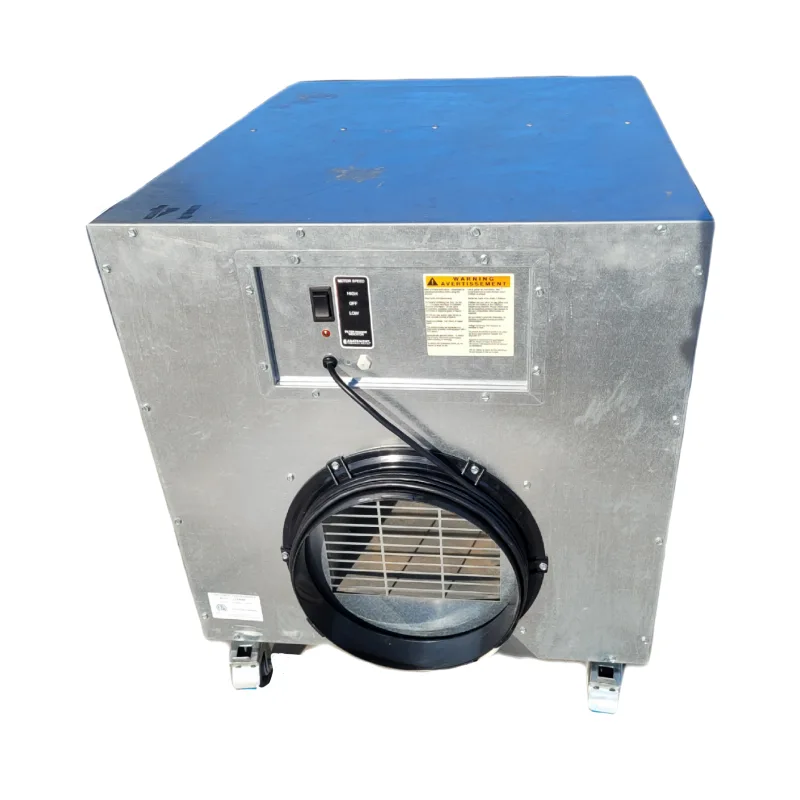
Same Box, Two Configurations
A HEPA filter captures particles at high efficiency. That is the component both configurations depend on, and it is the reason either machine is on site.
An air scrubber recirculates filtered air within a space. Air is drawn in, passed through filtration, and returned to the same room. The particle count in that room falls. The pressure in the room does not change, because the same volume of air that entered is leaving.
A negative air machine exhausts filtered air outside the containment. Air is drawn in, filtered, and ducted out, usually through a window or to an adjacent area. Because air is leaving and not returning, the pressure inside the containment drops below the pressure outside it.
That pressure difference is the entire point.
Why Pressure Decides the Direction of Failure
Containment is built from plastic sheeting and tape, and containment always leaks. Around door frames, at floor junctions, at penetrations, wherever the sheeting meets something irregular.
The question is never whether it leaks. It is which way.
Negative pressure causes air to flow into a containment area. With the interior at lower pressure, every leak becomes an inward leak. Clean air moves in. Contaminated air does not move out, because it cannot move against the pressure gradient.
Without negative pressure, the same leaks work in whichever direction the local air movement happens to favor, and any positive pressure inside, from an air mover pointed at the sheeting, from a door opening, will push contaminated air out into the occupied building.
|
Setup |
Air movement at leaks |
Consequence |
|
Sealed containment, no machine |
Uncontrolled, both directions |
Contamination escapes |
|
Air scrubber inside containment |
Neutral pressure, leaks both ways |
Cleaner air, no containment guarantee |
|
Negative air machine, exhaust outside |
Inward at every leak |
Contamination stays put |
|
Negative air machine, exhaust inside containment |
Neutral, no pressure difference |
Machine is an air scrubber |
The last row is the configuration error worth watching for. A negative air machine whose exhaust discharges back inside the containment is doing useful filtration and providing no containment whatsoever, and it looks identical from across the room.
What Air Changes per Hour Is Specifying
Air changes per hour measures how often the volume is filtered. Four air changes per hour means the machine processes a volume equal to the whole containment four times an hour.
It is calculated from the containment volume and the machine’s actual airflow, and the second number is where specifications go wrong. A machine’s rated airflow is measured with clean filters. As filters load, airflow falls, sometimes substantially. A unit specified at the margin with a fresh filter is under-performing within days.
Two practical consequences follow.
The first is that machines should be specified with headroom rather than exactly. The second is that airflow needs checking during the job rather than assumed from the nameplate, because the number that matters is what the machine is moving today.
Higher air change rates are appropriate for higher-risk work, and the appropriate figure is set by the protocol governing the job rather than chosen by preference.
Pre-Filters Are Not Optional
A pre-filter protects the HEPA filter from large particles. It is a cheap component that exists to keep an expensive one working.
Neglecting it is the most common maintenance failure on this equipment, and it produces a specific and expensive outcome. Without an effective pre-filter, the HEPA element loads with debris it was never meant to handle. Airflow falls, the air change rate falls with it, and the HEPA filter, which should last a long time, is destroyed early.
The staged approach is standard for a reason: a coarse pre-filter for bulk debris, sometimes a secondary filter, then the HEPA element. Changing the outer stages on schedule is inexpensive. Replacing HEPA filters that were killed by neglect is not.
A related point about rental equipment specifically: filter condition on arrival is worth checking rather than assuming. Equipment that comes from a supplier who services between hires arrives ready to perform at its rating, and that is a meaningful difference in what the machine actually delivers on site. It is one of the things worth knowing about the equipment rental operation behind these jobs, and the service area and hours cover the wider metro.
The Exhaust Route Nobody Plans
Negative air requires the exhaust to go somewhere outside the containment, and on a lot of jobs nobody thinks about where until the machine is being positioned.
The options each carry constraints.
- Through a window. Simplest, and it requires a window in the containment and a way to seal around the duct.
- To an adjacent uncontained space. Only acceptable where the filtered discharge is genuinely safe to release there, which depends on what is being contained.
- Through a wall or roof penetration. Effective, and it creates a repair.
- Long duct run to an exterior opening. Common on interior rooms, and every additional length of duct and every bend reduces airflow.
The last is the one that quietly undermines specifications. A machine rated for a given airflow and connected to a long, bent duct run is not delivering that airflow, and the air change calculation performed from the nameplate is now wrong.
Planning the exhaust route at the same time as the containment, rather than after it, is what prevents the setup where the only available route is a duct run that halves the machine’s performance.
The Regional Detail
Los Angeles County contains a large stock of pre-1980 housing, which is the structural fact that puts this equipment on a great many residential jobs in the region.
Building materials used before that period are more likely to contain substances that require containment when disturbed, which means renovation and remediation work on older properties routinely involves controlled work areas rather than open demolition. The governing protocols determine what is required, and they are not optional or discretionary.
The practical effect on equipment demand is that negative air is not an occasional specialist requirement here. It is a routine part of working on the region’s older housing stock, and the businesses doing that work need reliable access to properly maintained units rather than to whatever is available.
The climate adds a smaller consideration. Long dry periods mean fine dust is readily available to become airborne, and job sites with open access generate more particulate load than they would in a wetter region. That is a pre-filter consumption issue more than anything else, and it is another argument for checking filter condition rather than assuming it.
A Setup Checklist
Most containment failures trace to one of these being skipped, and all of them are checkable in a few minutes before work starts.
|
Check |
Looking for |
If wrong |
|
Exhaust discharges outside containment |
Duct leaves the sealed area |
Machine is only scrubbing, not containing |
|
Containment visibly drawn inward |
Sheeting pulled in, not billowing out |
No negative pressure, find the large leak |
|
Duct run as short and straight as possible |
Minimal length and bends |
Airflow below rating, calculation invalid |
|
Pre-filters clean and fitted |
Correct stages present |
HEPA loads early, airflow falls |
|
Airflow checked, not assumed |
Actual reading against rating |
Air changes lower than specified |
|
Entry through a sealed transition |
Not an open flap |
Pressure lost each time somebody enters |
The second row is the fastest diagnostic on any site. Correctly established containment visibly pulls inward. Sheeting that billows outward is announcing that pressure is positive and that contamination is being pushed into the occupied building.
It takes two seconds to look at and it is the check most often skipped, because the machine is running and the noise makes the setup feel like it is working.
What the Standard Advice Misses
Most published material treats these machines as interchangeable, using the terms as synonyms. The pressure difference is the whole function, and a piece of guidance that does not distinguish them will produce a setup that filters air and contains nothing.
The second omission is airflow degradation. Air change calculations are presented as arithmetic performed once, when the input falls continuously as filters load. A calculation done at setup and never revisited describes the first day of the job.
The third is the exhaust route, which appears in almost no guidance and determines whether the machine achieves its rating. Duct length and bends are not incidental installation details. They are part of the specification.
The Summary
An air scrubber and a negative air machine are frequently the same unit, and the difference is whether the filtered air is returned to the space or exhausted outside it.
Exhausting outside creates negative pressure, which turns every leak in the containment into an inward leak. Without it, containment leaks in whichever direction the air happens to move.
Air changes per hour depends on actual airflow, which falls as filters load, so specifications need headroom and mid-job checks rather than a one-time calculation.
Pre-filters are cheap and they exist to keep the expensive filter alive. And the exhaust route belongs in the plan, because a long ducted run quietly undoes the specification everyone agreed to.