
Celtic symbols appear everywhere in Ireland, from ancient stone carvings and illuminated manuscripts to jewellery, tattoos and modern artwork. Their looping lines, spirals and crosses are instantly recognisable, but their original meanings are not always as simple as they first appear.
Some designs date back thousands of years, while others developed during Ireland’s early Christian period or became popular much more recently. Many of the meanings attached to them today are based on folklore, religious tradition and modern interpretation rather than written explanations left by the original artists.
This guide explores the best-known Celtic symbols, what they are commonly believed to represent and where you may encounter them while travelling around Ireland. You can also explore more stories, designs and historical background in our collection of Celtic symbols and knots.
What Are Celtic Symbols?
Celtic symbols are decorative designs associated with the cultures, art and traditions of Celtic-speaking peoples. They include spirals, interlaced patterns, animals, crosses and geometric forms.
However, the word “Celtic” covers a broad range of communities that lived across different parts of Europe over many centuries. They were not a single unified nation with one fixed collection of symbols. The British Museum’s introduction to the Celts explains how Celtic identity and art developed across several regions and historical periods.
In Ireland, many designs commonly described as Celtic come from prehistoric monuments, Iron Age metalwork, early Christian manuscripts and medieval stone crosses. Their appearance and purpose changed as Irish society changed.
| Celtic symbol | Common modern meaning | Historical association |
|---|---|---|
| Triskele | Progress, movement and cycles | Prehistoric and later Celtic art |
| Triquetra | Eternity, unity and three-part balance | Interlaced medieval decoration |
| Celtic knot | Continuity and connection | Manuscripts, stonework and metalwork |
| Celtic cross | Faith and Irish heritage | Early medieval Christianity |
| Spiral | Growth, change and natural cycles | Prehistoric passage tomb art |
| Tree of life | Strength and connection | Nature-based folklore and modern Celtic art |
| Claddagh | Love, loyalty and friendship | Traditional Irish ring design |
| Ogham | Ancestry, language and identity | Early Irish writing system |
1. The Triskele or Triple Spiral
The triskele, also known as the triskelion or triple spiral, consists of three curved arms or spirals extending from a central point. It is one of the most recognisable designs associated with ancient Ireland.
A famous triple spiral appears at Newgrange in County Meath, although the monument predates the arrival of Celtic culture in Ireland by thousands of years. This is an important distinction because not every ancient Irish design was originally created by Celtic people.
Today, the triskele is commonly interpreted as representing movement, personal growth and the repeating cycles of life. Its three sections are also associated with groups such as past, present and future or land, sea and sky. These meanings are popular modern interpretations rather than confirmed translations from the people who first carved the symbol.
2. The Triquetra or Trinity Knot
The triquetra is formed from three interlocking pointed loops. Its name comes from Latin and means “three-cornered.” It is often called the Trinity Knot, particularly when used in Christian jewellery and artwork.
Early versions of similar three-part designs appeared in several cultures. In Ireland, the shape became closely associated with medieval interlaced art and Christian decoration.
The symbol is frequently used to represent the Christian Holy Trinity. In a broader modern setting, it may stand for three connected ideas, such as mind, body and spirit. Because its line appears to have no clear beginning or end, it is also used as a symbol of eternity.
3. Celtic Knots
Celtic knots are made from lines that weave over and under one another to create an unbroken pattern. Some are simple circular designs, while others form elaborate borders filled with animals, plants and geometric shapes.
Interlaced decoration can be seen in Irish manuscripts, metalwork and carved stone. The Book of Kells is one of the most famous examples, although knotwork was also used in other parts of Britain and Europe.
Modern interpretations often connect the continuous line with eternal love, loyalty, family or the interconnected nature of life. A particular knot does not necessarily have one universally accepted meaning, so be cautious of guides that claim every variation has a precise ancient definition.
4. The Celtic Cross
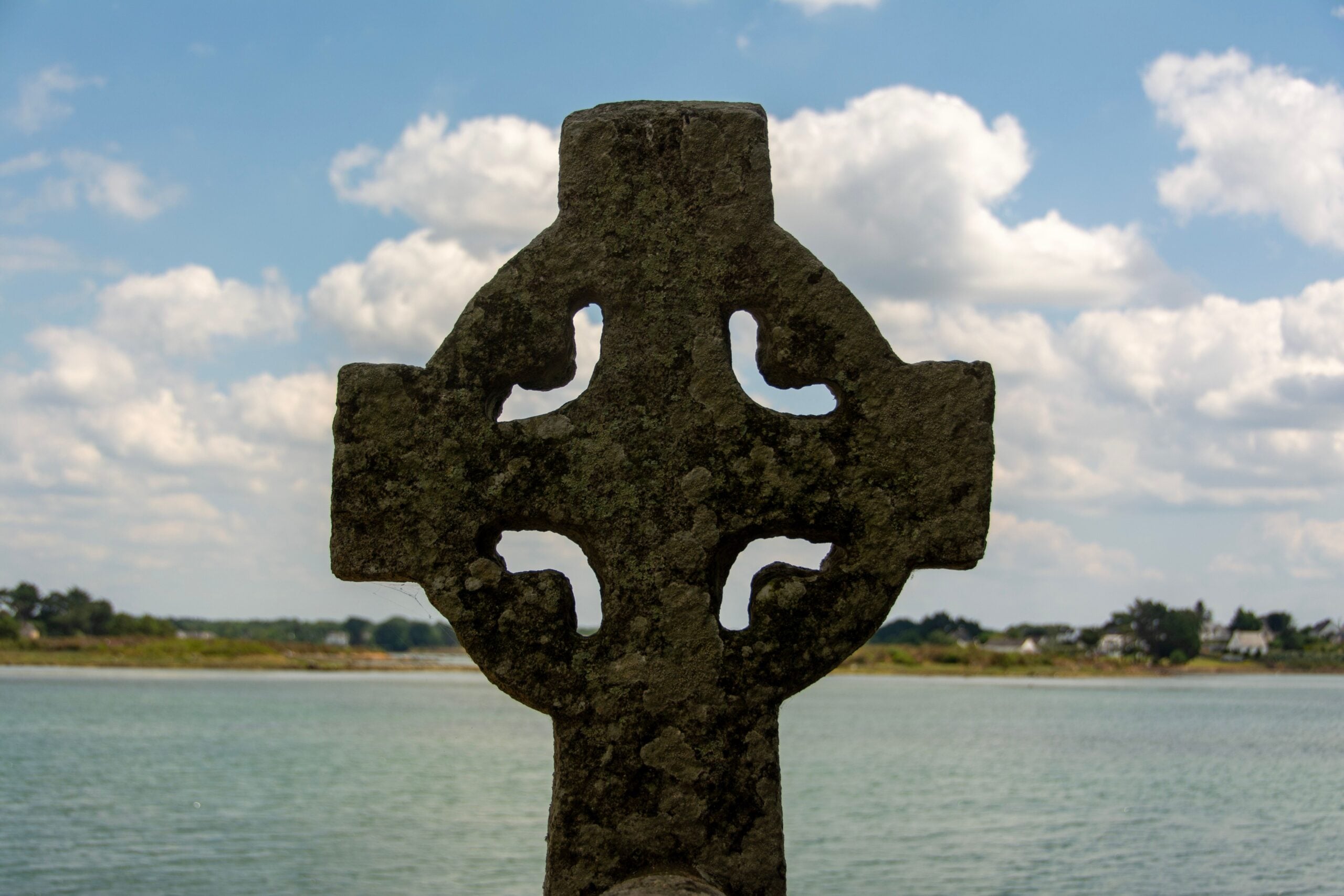
The Celtic cross normally features a Christian cross with a circular ring around the intersection of its arms. Large stone versions can be found at monastic and religious sites across Ireland.
Some of Ireland’s high crosses are covered with detailed biblical scenes, decorative panels and interlaced patterns. They were religious monuments and may also have served as teaching tools at a time when many people could not read.
The ring has been interpreted in several ways. It may have helped support the arms of early stone crosses, represented a halo or carried symbolic associations with eternity and the sun. Today, the Celtic cross is widely used as an expression of Christian faith, Irish ancestry or cultural heritage.
5. The Single and Double Spiral
Spirals are among the oldest designs found on Irish monuments. They appear in prehistoric passage tombs and on carved stones, often alongside circles, zigzags and diamond shapes.
A single spiral is now commonly associated with growth, energy and the journey through life. A double spiral may be interpreted as two opposing but connected forces, such as life and death or light and darkness.
Archaeologists cannot confirm exactly what every spiral meant to the people who carved it. The design may have held spiritual importance, marked astronomical observations or been used for reasons that have since been lost.
6. The Celtic Tree of Life
The Celtic Tree of Life is usually shown as a broad tree whose branches and roots curve together inside a circle. It is one of the most popular symbols in modern Celtic jewellery, wall art and tattoos.
Trees held practical and cultural importance in early Irish society. They provided food, shelter, fuel and materials, while wooded places also appear throughout Irish mythology and folklore.
The modern Tree of Life design is generally said to represent strength, wisdom and the connection between the earth and the heavens. Its roots may represent ancestry and stability, while its branches suggest growth and future generations.
7. The Claddagh
The Claddagh features a heart held by two hands and topped with a crown. It is most familiar as the design used on the traditional Irish Claddagh ring.
Each element has a commonly understood meaning. The heart represents love, the hands represent friendship and the crown represents loyalty. Together, they create one of Ireland’s clearest symbols of affection and commitment.
The Claddagh is strongly associated with Galway and takes its name from a historic fishing community beside Galway City. Unlike several ancient-looking motifs, the familiar ring design belongs to a much later period of Irish history.
8. St Brigid’s Cross
St Brigid’s Cross is traditionally woven from rushes and placed inside the home, often above a doorway. The most familiar design has four arms extending from a woven square in the centre.
The cross is associated with St Brigid, one of Ireland’s patron saints, and is traditionally made around the beginning of February. It has long been connected with protection, blessing and the arrival of spring.
There is no single historic design used throughout the country. The National Museum of Ireland’s collection of St Brigid’s crosses includes diamond-shaped, interlaced and wheel-shaped forms with different numbers of arms.
9. Ogham
Ogham is an early writing system found on standing stones in Ireland and parts of western Britain. Its characters are formed using groups of straight lines placed along or across a central edge.
Most surviving inscriptions contain personal names and may have marked territory, ancestry or memorials. Ogham is sometimes presented as a collection of magical Celtic symbols, but it was first and foremost a written alphabet.
It remains popular in necklaces, tattoos and wedding rings, particularly when used to spell an Irish name or meaningful word. The National Museum of Ireland describes Ogham as the earliest form of writing found in Ireland.
10. The Dara Knot
The Dara Knot is a modern Celtic-style design inspired by the roots of an oak tree. Its lines usually weave around one another to form a dense, symmetrical knot.
The name is commonly linked with the Irish word doire, meaning an oak wood or grove. Oak trees are associated with endurance, stability and wisdom, so the Dara Knot is generally used as a symbol of inner strength.
Although it is frequently described as an ancient Celtic symbol, there is no single standard historic Dara Knot. The name now covers several contemporary designs based on Celtic interlace and tree-root imagery.
11. The Shield Knot
The Shield Knot is usually a compact interlaced pattern with four distinct corners. It is often shown inside a circle or square and is commonly associated with protection.
Modern versions are worn as protective charms or used to represent security, family and resilience. Similar four-part knot patterns appear in decorative art from several cultures, which makes it difficult to assign the design exclusively to ancient Ireland.
It remains a popular choice for jewellery because its balanced shape works well on pendants, rings and small engraved objects.
12. Celtic Animals
Animals appear throughout Celtic and early Irish art, mythology and storytelling. Birds, horses, deer, boars, hounds and serpents could be used as decoration or connected with particular legendary figures.
-
- Hounds are commonly associated with loyalty, hunting and heroic warriors.
-
- Horses may represent status, movement, fertility or sovereignty.
-
- Boars are often connected with courage, strength and conflict.
-
- Ravens can be linked with prophecy, battle and the supernatural.
-
- Salmon are associated with knowledge in Irish myth, most famously in the story of the Salmon of Knowledge.
The meaning of an animal can change between stories, regions and historical periods. It is better to treat these associations as recurring themes rather than strict definitions.
Are the Popular Meanings of Celtic Symbols Accurate?
Some are based on established religious traditions, folklore or recognisable features of the design. Others have been developed by modern artists, jewellery makers and popular culture.
Ancient artists rarely left written descriptions explaining what an individual spiral, knot or animal represented. A symbol may also have changed meaning as it was reused by different communities.
This does not make modern interpretations meaningless. Symbols continue to gain significance through the people who wear, display and pass them down. It simply means that claims about a single “authentic” ancient meaning should be treated carefully.
Where to See Celtic Symbols in Ireland
You can find ancient and medieval designs at archaeological sites, museums, monasteries and churches throughout Ireland. Some of the best-known places include Newgrange, Knowth, Clonmacnoise, Monasterboice and the National Museum of Ireland in Dublin.
Look closely at stone crosses, grave slabs, manuscripts and metal objects. Many of the most impressive details are small, with birds, serpents and human figures woven into larger geometric patterns.
Modern versions can also be found in craft shops and jewellery studios, but quality and historical accuracy vary. Check whether a product is made in Ireland and whether the seller explains the origin of the design rather than simply attaching an invented ancient meaning to it.
Choosing a Celtic Symbol With Personal Meaning
You do not need to find a symbol with one rigid historical definition. A design can be meaningful because of your family background, a visit to Ireland, a personal value or the person who gave it to you.
The Claddagh is a natural choice for love and friendship, while St Brigid’s Cross is closely connected with Irish tradition and protection of the home. Ogham can be used to represent a name, and knotwork is often chosen for weddings, anniversaries and family gifts.
Understanding where the symbol came from will make the choice more personal while helping you separate genuine history from modern marketing.
Frequently Asked Questions About Celtic Symbols
What is the most famous Celtic symbol?
The Celtic cross, triquetra and triskele are among the most recognisable. In Ireland, the Claddagh and St Brigid’s Cross are also widely known.
What Celtic symbol represents family?
Celtic knots and the Tree of Life are commonly used to represent family. Their interconnected lines, roots and branches can symbolise shared ancestry and continuing generations.
What Celtic symbol represents strength?
The Dara Knot is generally associated with strength because its design is inspired by oak roots. Boars and oak trees may also be used to represent courage, resilience and endurance.
Do Celtic knots have different meanings?
Modern knot designs are often given meanings connected with love, protection or family. However, there is limited historical evidence showing that every knot pattern had its own fixed definition.
Is the shamrock an ancient Celtic symbol?
The shamrock is an important Irish emblem and is traditionally linked with St Patrick. However, its widespread use as a national symbol developed much later than Ireland’s prehistoric spirals and early medieval knotwork.
The Lasting Appeal of Celtic Designs
Celtic symbols have remained popular because they combine striking artwork with ideas that still feel relevant. Their spirals suggest movement, their knots create a sense of continuity and their natural imagery connects people with landscape, ancestry and tradition.
The history behind them is often more complicated than the short meanings printed beside jewellery displays. That complexity makes the designs more interesting, not less. Each one carries traces of Ireland’s prehistoric monuments, medieval craftsmanship, religious traditions and modern cultural identity.